- Circuit 1 and circuit 2.
- Circuit 2 and circuit 3.
- Circuit 3 and circuit 1.
- Circuit 1 only.


Explanation:
In circuit 1, one diode is forward biassed and the other diode is reverse biassed. The forward-biassed diode offers zero resistance (ideally) to the current flow, so it can be replaced by a short circuit. The voltage drop across the first diode will be zero. The second diode is reverse biassed, so it can be replaced by an open circuit; hence, the voltage drop across this diode will be maximum.
In circuit 2, both the diodes are forward biassed, so they can be replaced by short circuits; hence, the voltage drop across both of them will be minimum and equal.
In circuit 3, both the diodes are reverse biassed, so both can be replaced by open circuits; hence, the voltage drop across both of them will be maximum and equal.

Generate a complete, print-ready paper with questions like this in minutes — across 16+ boards, with answer keys.

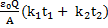
Between the plates of a parallel plate condenser, a plate of thickness
and dielectric constant
is placed. In the rest of the space, there is another plate of thickness
and dielectric constant
. The potential difference across the condenser will be
|
(a) |
(b) |
(c) |
(d) |
The magnetic field due to the earth is closely equivalent to that due to
|
(a) A large magnet of length equal to the diameter of the earth |
| (b) A magnetic dipole placed at the centre of the earth |
| (c) A large coil carrying current |
| (d) Neither of the above |
Assertion : There is no atmosphere on moon
Reason : Escape velocity at the surface of moon is low.
|
(a) If both assertion and reason are true and the reason is the correct explanation of the assertion. |
|
(b) If both assertion and reason are true but reason is not the correct explanation of the assertion. |
|
(c) If assertion is true but reason is false. |
|
(d) If the assertion and reason both are false. |
Two particle of equal mass m and charge q are placed at a distance of 16 cm. They do not experience any force. The value of
is
|
(a) l |
(b) |
(c) |
(d) |
A proton (or charged particle) moving with velocity v is acted upon by electric field E and magnetic field B. The proton will move undeflected if
|
(a) E is perpendicular to B |
|
(b) E is parallel to v and perpendicular to B |
|
(c) E, B and v are mutually perpendicular and |
|
(d) E and B both are parallel to v |