Question
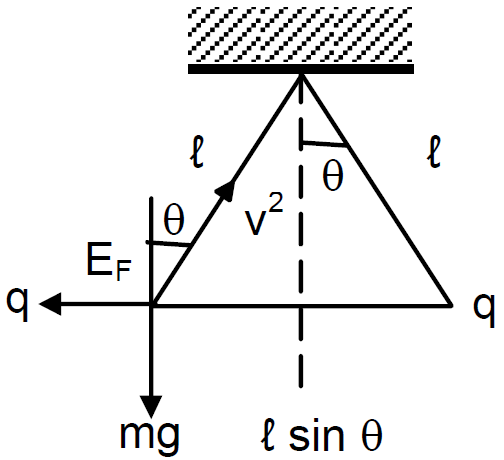
Two identical pith balls, each carrying a charge q, are suspended from a common point by two strings of equal length l. Find the mass of each ball if the angle between the strings is $2\theta$ in equilibrium.
Answer


Electric force $=\frac{\text{kq}^2}{(\ell\sin\text{Q}+\ell\sin\text{Q})^2}$

$=\frac{\text{kq}^2}{4\ell^2\sin^2}$

So, $\text{T}\cos\theta=\text{ms}$ (For equilibrium) $\text{T}\sin\theta=\text{Ef},$

$\text{tan}\theta=\frac{\text{Ef}}{\text{mg}}$
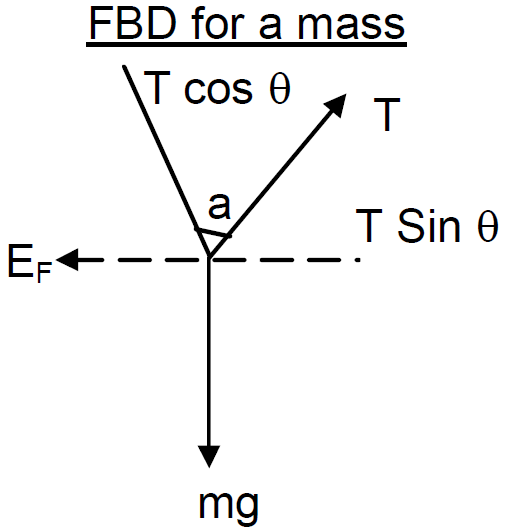
$\Rightarrow\text{mg}=\text{Ef}\cot\theta$

$=\frac{\text{kq}^2}{4\ell^2\sin^2\theta}\cot\theta$

$=\frac{\text{q}^2\cot\theta}{\ell^2\sin^2\theta16\pi\text{E}_0}$

$\text{m}=\frac{\text{q}^2\cot\theta}{16\pi\text{E}_0\ell^2\sin^2\theta\text{g}}\text{unit}$

Need a full question paper?

Generate a complete, print-ready paper with questions like this in minutes — across 16+ boards, with answer keys.

Start Generating Free

Similar questions

Suppose all the electrons of 100g water are lumped together to form a negatively charged particle and all the nuclei are lumped together to form a positively charged particle. If these two particles are placed 10.0cm away from each other, find the force of attraction between them. Compare it with your weight.
  1. An object is placed in front of a concave mirror. It is observed that a virtual image is formed. Draw the ray diagram to show the image formation and hence derive the mirror equation $\frac{1}{\text{f}}=\frac{1}{\text{u}}+\frac{1}{\text{v}}.$
  2. An object is placed 30cm in front of a plano-convex lens with its spherical surface of radius of curvature 20cm. If the refractive index of the material of the lens is 1.5, find the position and nature of the image formed.
Write Einstein's photoelectric equation and explain any two observations related to the photoelectric effect.
A uniform magnetic field of 1.5 T exists in a cylindrical region of radius10.0 cm, its direction parallel to the axis along east to west. A wire carrying current of 7.0 A in the north to south direction passes through this region. What is the magnitude and direction of the force on the wire if,
  1. The wire intersects the axis,
  2. The wire is turned from N-S to northeast-northwest direction,
  3. The wire in the N-S direction is lowered from the axis by a distance of 6.0 cm?
Consider a system of n charges q1, q2, ... qn with position vectors $\vec{\text{r}}_1,\vec{\text{r}}_2,\vec{\text{r}}_3,...\vec{\text{r}}_\text{n}$ relative to some origin ‘O’. Deduce the expression for the net electric field $\vec{\text{E}}$ at a point P with position vector $\vec{\text{r}}_\text{p},$ due to this system of charges.
A gravitational lens may be assumed to have a varying width of the form
$\text{w}(\text{b})=\text{k}_1\text{ In }\Big(\frac{\text{k}_2}{\text{b}}\Big)\ \ \text{b}_\text{min}<\text{b}<\text{b}_\text{max}$
$=\text{k}_1\text{ In }\Big(\frac{\text{k}_2}{\text{b}_\text{min}}\Big)\ \ \text{b}<\text{b}_\text{min}$
Show that an observer will see an image of a point object as a ring about the center of the lens with an angular radius
$\beta=\sqrt{\frac{(\text{n}-1)\text{k}_1\frac{\text{u}}{\text{v}}}{\text{u}+\text{v}}}$
i. Prove that an ideal capacitor in an ac circuit does not dissipate power.
ii. An inductor of 200 mH, a capacitor of $400 \mu f$, and a resistor of $10 \Omega$ are connected in series to ac source of 50 V of variable frequency. Calculate the
a. the angular frequency at which maximum power dissipation occurs in the circuit and the corresponding value of the effective current and
b. value of Q-factor in the circuit.
Two particles A and B, each carrying a charge Q, are held fixed with a separation d between them. A particle C having mass m and charge q is kept at the middle point of the line AB.
  1. If it is displaced through a distance x perpendicular to AB, what would be the electric force experienced by it.
  2. Assuming x << d, show that this force is proportional to x.
  3. Under what conditions will the particle C execute simple harmonic motion if it is released after such a small displacement?
Find the time period of the oscillations if these conditions are satisfied.
A small piece of cesium metal ($\phi$ = 1 ·9 eV) is kept at a distance of 20cm from a large metal plate having a charge density of 1.0 × 10⁻⁹C/m2 on the surface facing the cesium piece. A monochromatic light of wavelength 400nm is incident on the cesium piece. Find the minimum and the maximum kinetic energy of the photoelectrons reaching the large metal plate. Neglect any change in electric field due to the small piece of cesium present.
The wavelengths of $\text{K}_\alpha$ and $\text{L}_\alpha$ X-rays of a material are 21.3pm and 141pm respectively. Find the wavelength of $\text{K}_\beta$ X-ray of the material.