MCQ
Two incident monochromatic waves whose wavelengths differ by a small amount $d\lambda$ are separated angularly at $\theta$ and $\theta + d\theta$ $w.r.t$. the incidence ray. The dispersive power is given by
  • A
    $d\theta /\theta$
  • $d\theta /d\lambda$
  • C
    $d\lambda /\lambda$
  • D
    $\lambda (d\lambda /d\theta )$

Answer

Correct option: B.
$d\theta /d\lambda$
b
Angular dispersion $=\theta+d \theta-\theta$ $=d \theta$

deviation in mean ray $= d \lambda$

Dispersive power, $\omega=\frac{\text { Angular digpersion }}{\text { Deviation in mean ray }}$ $=\frac{ d \theta}{ d \lambda}$

Need a full question paper?

Generate a complete, print-ready paper with questions like this in minutes — across 16+ boards, with answer keys.

Start Generating Free

Similar questions

We have a galvanometer of resistance 25 Ω. It is shunted by a 2.5 Ω wire. The part of total current that flows through the galvanometer is given as
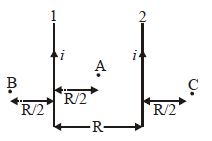
Two long parallel wires are at a distance $R$ apart. They carry steady equal currents in the same directions as shown in the figure. The ratio of magnetic fields at $A, B$ and $C$ respectively, is
During mean life of a radioactive element, the fraction that disintegrates is
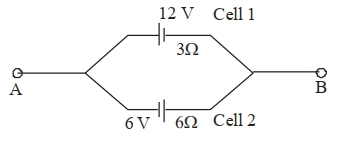
Two cells are connected between points $A$ and $B$ as shown. Cell $1$ has emf of $12\,V$ and internal resistance of $3\,\Omega$. Cell $2$ has emf of $6\,V$ and internal resistance of $6\,\Omega$. An external resistor $R$ of $4\,\Omega$ is connected across $A$ and $B$. The current flowing through $R$ will be $.............A$.
Assertion : Radioactivity of $10^8$ undecayed radioactive nuclei of half life of 50 days is equal to that of $1.2 \times 10^8$ number of undecayed nuclei of some other material with half life of 60 days
Reason : Radioactivity is proportional to half-life.
A uniform electric field and a uniform magnetic field are produced, pointed in the same direction. An electron is projected with its velocity pointing in the same direction
A space or region around a magnet in which a force is experienced by magnetic pole is called.
The rays of different colours fail to converge at a point after going through a converging lens. This defect is called:
In a Young's double slit experiment, a student observes $8$ fringes in a certain segment of screen when a monochromatic light of $600\,nm$ wavelength is used. If the wavelength of light is changed to $400\,nm$, then the number of fringes he would observe in the same region of the screen is:
A galvanometer, having a resistance of $50 \,\Omega$ gives a full scale deflection for a current of $0.05\, A$. The length in meter of a resistance wire of area of cross-section $2.97× 10^{-2} \,cm^2$ that can be used to convert the galvanometer into an ammeter which can read a maximum of $5\, A$ current is (Specific resistance of the wire = $5 × {10^{ - 7}}\,\Omega m$)