MCQ
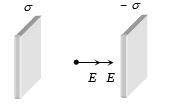
Two infinitely long parallel conducting plates having surface charge densities $ + \sigma $ and $ - \sigma $ respectively, are separated by a small distance. The medium between the plates is vacuum. If ${\varepsilon _0}$ is the dielectric permittivity of vacuum, then the electric field in the region between the plates is
  • A
    $0\,volts/meter$
  • B
    $\frac{\sigma }{{2{\varepsilon _o}}} volts/meter$
  • $\frac{\sigma }{{{\varepsilon _o}}} volts/meter$
  • D
    $\frac{{2\sigma }}{{{\varepsilon _o}}} volts/meter$
Answer

Correct option: C.
$\frac{\sigma }{{{\varepsilon _o}}} volts/meter$
c
(c) Electric field between the plates is
$ = \frac{\sigma }{{2{\varepsilon _0}}} - \frac{{( - \sigma )}}{{2{\varepsilon _0}}}$
$ = \frac{\sigma }{{{\varepsilon _0}}}\,volt/meter$

Need a full question paper?

Generate a complete, print-ready paper with questions like this in minutes — across 16+ boards, with answer keys.

Start Generating Free

Similar questions

$\pi $ mesons can be
A positively charged rod is brought near an uncharged conductor. If the rod is then suddenly withdrawn, the charge left on the conductor will be:
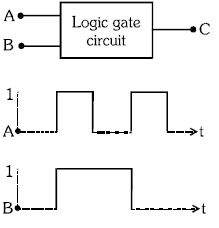
The following figure shows a $AND$ logic gate circuit with two inputs $A$ and $B$ and the output $C$. The voltage waveforms of $C$ will be
For a thermocouple, the neutral temperature is 270℃ and the temperature of its cold junction is 20℃. If there is no deflection in the galvanometer, the temperature of the hot junction should be
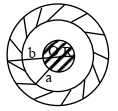
A solid metal sphere of radius $R$ having charge $q$ is enclosed inside the concentric spherical shell of inner radius $a$ and outer radius $b$ as shown in figure. The approximate variation electric field $\overrightarrow{{E}}$ as a function of distance $r$ from centre $O$ is given by
Two light beams of intensities $4\,I$ and $9\,I$ interfere on a screen. The phase difference between these beams on the screen at point $A$ is $zero$ and at point $B$ is $\pi$. The difference of resultant intensities, at the point $A$ and $B$, will be $....I$.
An electron is moving along the positive $x$-axis. If the uniform magnetic field is applied parallel to the negative $z$-axis. then

$A.$ The electron will experience magnetic force along positive $y$-axis

$B.$ The electron will experience magnetic force along negative $y$-axis

$C.$ The electron will not experience any force in magnetic field

$D.$ The electron will continue to move along the positive $x$-axis

$E.$ The electron will move along circular path in magnetic field

Choose the correct answer from the options given below:

In an inductor of self-inductance $L = 2\,mH,$ current changes with time according to relation $i = t^2e^{-t}$. At what time $emf$ is zero?.....$s$
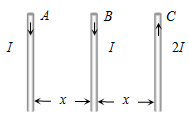
A, B and C are parallel conductors of equal length carrying currents I, I and 2I respectively. Distance between A and B is x. Distance between B and C is also x. $F_1$ is the force exerted by B on A and $F_2$ is the force exerted by B on A choose the correct answer
The ultimate individual unit of magnetism in any magnet is called