Question
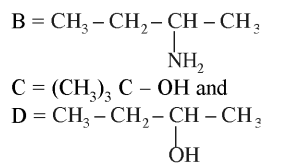
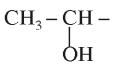
Two isomeric compounds (A and B) have $C _4 H _{11} N$ molecular formula react with $HNO _2$ and forms compounds (C) and (D). C is hardly oxidised but it reacts immediately with Lucas reagent whereas $D$ reacts with Lucas reagent in 5 minutes and it also gives haloform reaction. Identify $A, B, C$ and $D$.
Need a full question paper?

Generate a complete, print-ready paper with questions like this in minutes — across 16+ boards, with answer keys.

Start Generating Free

Similar questions

Coagulation of egg white on boiling is an example of denaturation of protein. Explain it in terms of structural changes.
Which alkyl halide from the following pairs would you expect to react more rapidly by an SN2 mechanism? Explain your answer.
$\text{CH}_3\text{CH}_2\text{CH}_2\text{CH}_2\text{Br}\ \text{or}\ \text{CH}_3\text{CH}_2\text{CH}\text{CH}_3\\\ \ \ \ \ \ \ \ \ \ \ \ \ \ \ \ \ \ \ \ \ \ \ \ \ \ \ \ \ \ \ \ \ \ \ \ \ \ \ \ \ \ \ \ \ \ \ \ \ \ \ \ \ \ \ \ \mid\\\ \ \ \ \ \ \ \ \ \ \ \ \ \ \ \ \ \ \ \ \ \ \ \ \ \ \ \ \ \ \ \ \ \ \ \ \ \ \ \ \ \ \ \ \ \ \ \ \ \ \ \ \ \ \ \text{Br}$
What is battery? Give it's types.
Answer the following:
(a) For a chemical reaction, what is the effect of catalyst on the rate of the reaction.
(b) Why is the probability of reaction with molecularity higher than three very rare?
Accomplish the following conversion:
Aniline to 2, 4, 6 -tribromofluorobenzene.
Explain why :
alkyl halides, though polar, are immiscible with water?
Which sugar is called invert sugar? Why is it called so?
(a) How will you distinguish between the following pairs of compounds :
(i) Aniline and Ethanamine
(ii) Aniline and $N$-methylaniline
(b) Arrange the following compounds in decreasing order of their boiling points :
Butanol, Butanamine, Butane.
How would you determine the standard electrode potential of the system Mg2+|Mg?
Given that the standard electrode potentials (Eo) of metals are:
K+/K = –2.93 V, Ag+/Ag = 0.80 V, Cu2+/Cu = 0.34 V,
Mg2+/Mg = -2.37 V, Cr3+/Cr = – 0.74 V, Fe2+/Fe = – 0.44 V.
Arrange these metals in an increasing order of their reducing power.