Question
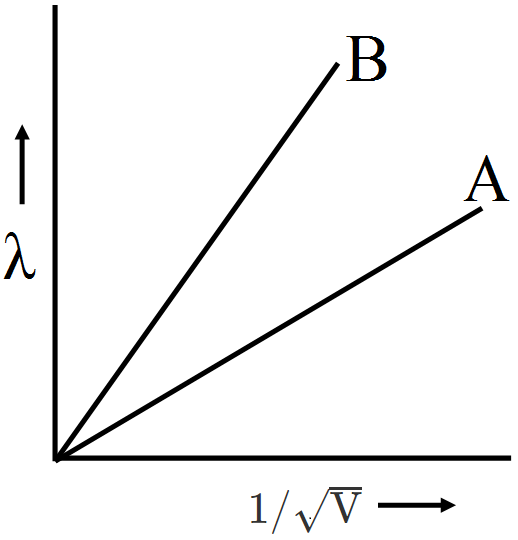
Two lines A and B shown in the graph represent the de Broglie wavelength $(\lambda)$ as a function of $\frac{1}{\sqrt{\text{V}}}$ (V is the accelerating potential) for two particles having the same charge. Which of the two represents the particle of smaller mass?
Answer

de Broglie wavelength $\lambda=\frac{\text{h}}{\sqrt{2\text{mqV}}}$ or $\lambda=\frac{\text{h}}{\sqrt{2\text{mq}}}.\frac{1}{\sqrt{\text{V}}}$
The graph of $\lambda$ versus $\frac{1}{\sqrt{\text{V}}}$ is a straight line of slope $\frac{\text{h}}{\sqrt{2\text{mq}}}\propto\frac{1}{\sqrt{\text{m}}}.$ The slope of line B is large, so particle B has smaller mass.

Need a full question paper?

Generate a complete, print-ready paper with questions like this in minutes — across 16+ boards, with answer keys.

Start Generating Free

Similar questions

Derive the formula for electrostatic potential due to a point charge.
Write down two uses of potentiometer.
The masses of $^{11}C$ and $^{11}B$ are respectively $11.0114u$ and $11.0093u$. Find the maximum energy a positron can have in the $\beta^+-$ decay of $^{11}C$ to $^{11}B$.
How does the electric field inside a dielectric decrease when it is placed in an external electric field?
Two transparent slabs having equal thickness but different refractive indices $\mu_1$ and $\mu_2$ are pasted side by side to form a composite slab. This slab is placed just after the double slit in a Young's experiment so that the light from one slit goes through one material and the light from the other slit goes through the other material. What should be the minimum thickness of the slab so that there is a minimum at the point $P_0$ which is equidistant from the slits?
An electric field $\vec{\text{E}}=(\vec{\text{i}}20+\vec{\text{j}}30)\text{N}\text{C}^{-1}$ exists in the space. If the potential at the origin is taken to be zero, find the potential at (2m, 2m).
What is paramagnetic substance?
Radii of two circular current carrying coils are $r_1$ and $r_2$ respectively and number of turns in them are $n_1$ and $n_2$ respectively. They are joined in series. Prove that the ratio of produced magnetic fields at their centers is $n_1 r_2: n_2 r_1$. If coils are joined in parallel, then the ratio of magnetic fields produced at the centers is equivalent to $\left(r_2 / r_1\right)^2$.
Why is Wheatstone bridge (Metre Bridge) method not suitable for measurement of very low and very high resistances?
Calculate the value of $i$ as shown in the figure.
Image