Question
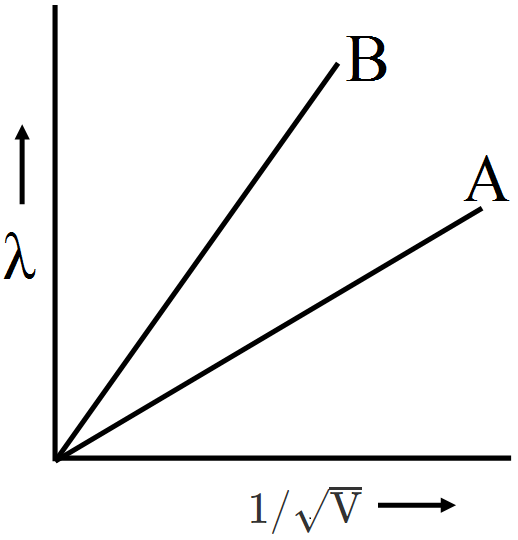
Two lines A and B shown in the graph represent the de Broglie wavelength $(\lambda)$ as a function of $\frac{1}{\sqrt{\text{V}}}$ (V is the accelerating potential) for two particles having the same charge. Which of the two represents the particle of smaller mass?
Answer

de Broglie wavelength $\lambda=\frac{\text{h}}{\sqrt{2\text{mqV}}}$ or $\lambda=\frac{\text{h}}{\sqrt{2\text{mq}}}.\frac{1}{\sqrt{\text{V}}}$
The graph of $\lambda$ versus $\frac{1}{\sqrt{\text{V}}}$ is a straight line of slope $\frac{\text{h}}{\sqrt{2\text{mq}}}\propto\frac{1}{\sqrt{\text{m}}}.$ The slope of line B is large, so particle B has smaller mass.

Need a full question paper?

Generate a complete, print-ready paper with questions like this in minutes — across 16+ boards, with answer keys.

Start Generating Free

Similar questions

Draw the series L-C-R AC circuit and obtain the relationship between voltage and current for this circuit. (Derive the necessary equations.)
Light of wavelength 560nm goes through a pinhole of diameter 0.20mm and falls on a wall at a distance of 2.00m. What will be the radius of the central bright spot formed on the wall?
What is reflection of light? Define angle of incidence and angle of reflection.
The electric field E due to any point charge near it is defined as $\text{E}=\lim\limits_{\text{q}\rightarrow0}\frac{\text{F}}{\text{q}}$ where q is the test charge and F is the force acting on it. What is the physical significance of $\lim\limits_{\text{q}\rightarrow0}$ in this expression?
Draw the electric lines of point charge Q when,
  1. Q > 0
  2. Q < 0.

During an experiment, an ideal gas is found to obey an additional law pV2 = constant. The gas is initially at a temperature T and volume V. Find the temperature when it expands to a volume 2V.
A potential difference of 12 volt is applied across the ends of 0.24 m long conductor. Calculate the drift velocity of the electrons. Mobility of electron is $5.6 \times 10^{-6} m^2 V^{-1} s^{-1}$.
Explain dielectric strength and dielectric breakdown.
Derive the formula for the torque acting on a dipole placed in a uniform external electric field.
Find the electric force between two protons separated by a distance of 1 fermi (1 fermi = 10-15m). The protons in a nucleus remain at a separation of this order.
Figure shows a 2.0 V potentiometer used for the determination of internal resistance of a 1.5 V cell. The balance point of the cell in open circuit is 76.3 cm. When a resistor of $9.5\ \Omega$ is used in the external circuit of the cell, the balance point shifts to 64.8 cm length of the potentiometer wire. Determine the internal resistance of the cell.