Question
Derive the formula for the torque acting on a dipole placed in a uniform external electric field.
Answer


Image
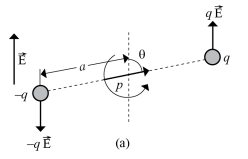
→ As shown in figure, the electric dipole is placed in uniform electric field at $\theta$ angle.
→The force exerted on $+q$ electric charge in electric field $\overrightarrow{ E }_{\text {is }}$,
$
\overrightarrow{F}+=q \overrightarrow{E}
$
→ The force exerted on - $q$ electric charge
$
\overrightarrow{F}_{-}=-q \overrightarrow{E}
$
→ The net force on the dipole is zero, since $E$ is uniform.
→ However, the charges are separated, so the forces act at different points, resulting in a torque on the dipole.
→ When the net force is zero, the torque (couple) is independent of the origin. Its magnitude equals the magnitude of each force multiplied by the arm of the couple (perpendicular distance between the two antiparallel forces).
→ Magnitude of torque $=q E \times 2 a \sin \theta$
$
\begin{array}{l}
=(2 q a) E \sin \theta=p E \sin \theta \\
\vec{\tau}=\vec{p} \cdot \overrightarrow{E}
\end{array}
$
→ The magnitude of $\vec{p} \times \overrightarrow{ E }$ is also $p E \sin \theta$ and its direction is normal to the paper, coming out of it.
→ Special cases :
(i) If electric dipole moment and electric field both are in one direction.
$
\begin{array}{l}
\therefore \theta=0 \\
\therefore \tau=0
\end{array}
$
This condition is called stable equilibrium.
(ii) Both electric dipole moment and electric field are perpendicular.
$
\therefore \theta=\frac{\pi}{2}
$
$\therefore \tau=p E \sin \frac{\pi}{2}$
$\therefore \tau=p E \rightarrow$ Which is maximum
(iii) Electric dipole moment and electric field are arranged anti parallel direction.
$
\begin{array}{l}
\therefore \tau=pE \sin \pi \\
\therefore \tau=0 \rightarrow \text { Unstable equilibrium }
\end{array}
$

Need a full question paper?

Generate a complete, print-ready paper with questions like this in minutes — across 16+ boards, with answer keys.

Start Generating Free

Similar questions

Consider the situation shown in figure. Initially the spring is unstretched when the system is released from rest. Assuming no friction in the pulley, find the maximum elongation of the spring.

Each side of a square is 90 cm long. At its corners $-2,+3,-4$ and +5 micro coulomb charges are placed respectively. Find the electric potential at the centre of the square.
A boy is standing on a platform which is free to rotate about its axis. The boy holds an open umbrella in his hand. The axis of the umbrella coincides with that of the platform. The moment of inertia of ''the platform plus the boy system'' is 3.0 × 10⁻³kg-m2 and that of the umbrella is 2.0 × 10³kg-m2. The boy starts spinning the umbrella about the axis at an angular speed of 2.0rev/s with respect to himself. Find the angular velocity imparted to the platform.
The voice of a person, who has inhaled helium, has a remarkably high pitch. Explain on the basis of resonant vibration of vocal cord filled with air and with helium.
Answer the following questions:
A capacitor is used in the primary circuit of an induction coil.
State Bohr’s quantization condition of angular momentum. Calculate the shortest wavelength of the Bracket series and state to which part of the electromagnetic spectrum does it belong.
Sunita and her friends went to an exhibition. The guard standing there asked them to pass through a metal detector. Sunita's friends were first afraid but when Sunita told them the reason and explain its working.
Answer the following questions :
(a) State the principle on which metal detector works.
(b) If a person passing through metal detector has some metallic object then why does it produces sound?
(c) Tell two qualities of Sunita which she showed while explaining the reason for passing through it.
The focal length of a convex lens made of glass is 20cm. What will be its new focal length when placed in a medium of refractive index 1.25?
Provide explanation of Energy bands, valence band and conduction band.
Draw a p-n junction which is reverse biased.