MCQ
Two long capillary tubes $A$ and $B$ of radius $R>R$ dipped in same liquid. Then
  • Water rise is more in $A$ than $B$
  • B
    Water rises more in $B$ than $A$
  • C
    Same water rise in both
  • D
    All of these according to the density of water

Answer

Correct option: A.
Water rise is more in $A$ than $B$
(a) $h \propto \frac{1}{R}$

Need a full question paper?

Generate a complete, print-ready paper with questions like this in minutes — across 16+ boards, with answer keys.
Start Generating Free

Similar questions

The field of view is maximum for
The radius of the coil of a Tangent galvanometer. which has 10 turns is $0.1 \mathrm{~m}$. The current required to produce a deflection of $60^{\circ}$ $\left(B_H=4 \times 10^{-5} T\right)$ is
A body executing simple harmonic motion has a maximum acceleration equal to $24$ metres $/ sec ^2$ and maximum velocity equal to $16$ metres $/ sec$. The amplitude of the simple harmonic motion is
An object of $1 \mathrm{~kg}$ mass has a momentum of $10 \mathrm{~kg} \mathrm{~m} / \mathrm{sec}$ then the kinetic energy of the object will be
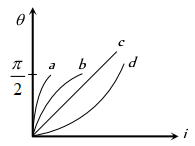
Which curve may best represent the current deflection in a tangent galvanometer

Image

A plane mirror makes an angle of $30^{\circ}$ with horizontal. If a vertical ray strikes the mirror, find the angle between mirror and reflected ray
A body of mass $2 \mathrm{~kg}$ is thrown up vertically with K.E. of $490$ joules. If the acceleration due to gravity is $9.8 \mathrm{~m} / \mathrm{s}^2$, then the height at which the K.E. of the body becomes half its original value is given by
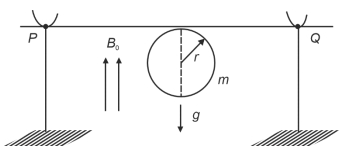
A thin stiff insulated metal wire is bent into a circular loop with its two ends extending tangentially from the same point of the loop. The wire loop has mass $m$ and radius $r$ and it is in a uniform vertical magnetic field $B_0$, as shown in the figure. Initially, it hangs vertically downwards, because of acceleration due to gravity $g$, on two conducting supports at $P$ and $Q$. When a current $/$ is passed through the loop, the loop turns about the line $P Q$ by an angle $\theta$ given by
A particle is kept at rest at the top of a sphere of diameter $42 m$. When disturbed slightly, it slides down. At what height ' $h$ ' from the bottom, the particle will leave the sphere
Surface temperature of the sun is of the order of