MCQ
According to Joule's law, if the potential difference across a conductor having a material of specific resistance remains constant, then the heat produced in the conductor is directly proportional to
  • A
    $\rho $
  • B
    ${\rho ^2}$
  • C
    $\frac{1}{{\sqrt \rho }}$
  • $\frac{1}{\rho }$

Answer

Correct option: D.
$\frac{1}{\rho }$
d
(d) $P = \frac{{{V^2}}}{R}$ but $R = \frac{{\rho l}}{A}$ $ \Rightarrow $ $P = \frac{{{V^2}}}{{\rho l/A}} = \frac{{A{V^2}}}{{\rho l}}$. Since $\frac{{A{V^2}}}{l}$is constant as per given conditions So $P \propto \frac{1}{\rho }$.

Need a full question paper?

Generate a complete, print-ready paper with questions like this in minutes — across 16+ boards, with answer keys.

Start Generating Free

Similar questions

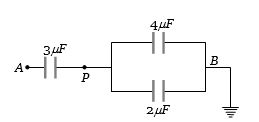
In the figure a potential of $+$ $1200\, V$ is given to point $A$ and point $B$ is earthed, what is the potential at the point $P$....$V$
Consider the following two statements
A. Energy spectrum of a-particles emitted in radioactive decay is discrete
B. Energy spectrum of b-particles emitted in radioactive decay is continuous
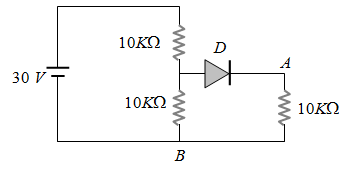
In the given figure, potential difference between A and B is

The coefficient of self inductance of a solenoid is $0.18\, mH$. If a crode of soft iron of relative permeability $900$ is inserted, then the coefficient of self inductance will become nearly.....$mH$
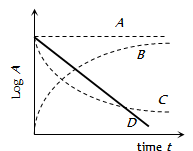
The graph which represents the correct variation of logarithm of activity (log A) versus time, in figure is
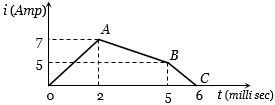
The current through a $4.6\, H$ inductor is shown in the following graph. The induced emf during the time interval $t = 5\, milli-sec$ to $6\,milli-sec$ will be
If in a nuclear fission, piece of uranium of mass 0.5 g is lost, the energy obtained in kWh is
A ray is reflected in turn by three plain mirrors mutually at right angles to each other. The angle between the incident and the reflected rays is......$^o$
The image of an extended object, placed perpendicular to the principal axis of a mirror, will be erect if:
A plane electromagnetic wave propagating in $\mathrm{x}$-direction is described by

$\mathrm{E}_{\mathrm{y}}=\left(200\  \mathrm{Vm}^{-1}\right) \sin \left[1.5 \times 10^7 \mathrm{t}-0.05\  \mathrm{x}\right] \text {; }$

The intensity of the wave is :(Use $\in_0=8.85 \times 10^{-12} \mathrm{C}^2 \mathrm{~N}^{-1} \mathrm{~m}^{-2}$ )