MCQ
Two magnetic lines of force:
- ANever cut each other.
- BCut near the poles.
- CCut according to the position of the magnet.
- DCut at neutral points.
Explanation:
A magnetic field line is that path in space that points in the direction of the magnetic field at every point along it. Walk along a magnetic field line carrying a compass, and the needle will always point in the direction you need to go in order to stay on that magnetic field line (the needle has to be able to pivot up and down as well as around in a circle like most compasses).
If two field lines crossed, then that is resembling that the magnetic field points in two different directions, at one place. There is only one direction to the magnetic field at any place at any time, so this doesn't happen.
Generate a complete, print-ready paper with questions like this in minutes — across 16+ boards, with answer keys.
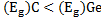
Carbon, silicon and Germanium atoms have four valence electrons each. Their valence and conduction band are separated by energy band gaps represented by (Eg)C. (Eg)Si and (Eg)Ge respectively. Which one of the following relationship is true in their case
|
(a) ( |
(b) |
(c) |
(d) |
A hydrogen atom in its ground state absorbs 10.2 eV of energy. The orbital angular momentum is increased by
|
(a) 1.05 |
(b) 3.16 |
(c) 2.11 |
(d) 4.22 |
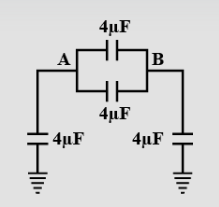
If E is the electric field intensity of an electrostatic field, then the electrostatic energy density is proportional to
|
(a) E |
(b) |
(c) |
(d) |
The equivalent resistance of the circuit shown in the figure is

|
(a) 8 W |
(b) 6 W |
(c) 5 W |
(d) 4 W |
The apparent wavelength of the light from a star moving away from the earth is 0.01% more than its real wavelength. Then the velocity of star is
|
(a) 60 km/sec |
(b) 15 km/sec |
(c) 150 km/sec |
(d) 30 km/sec |
According to Bohr's model, the radius of the second orbit of helium atom is
|
(a) 0.53 Å |
(b) 1.06 Å |
(c) 2.12 Å |
(d) 0.265 Å |