Two masses $m_1$ and $m_2$ are suspended together by a massless spring of constant $K$. When the masses are in equilibrium, $m_1$ is removed without disturbing the system. The amplitude of oscillations is

Medium


Download our appand get started for free
Experience the future of education. Simply download our apps or reach out to us for more information. Let's shape the future of learning together!No signup needed.*
Similar Questions
- 1A simple pendulum performs simple harmonic motion about $X = 0$ with an amplitude $A$ and time period $T$. The speed of the pendulum at $X = \frac{A}{2}$ will beView Solution
- 2View SolutionA tunnel has been dug through the centre of the earth and a ball is released in it. It will reach the other end of the tunnel after
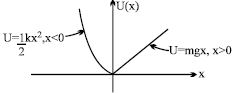
- 3A particle of mass $m$ moves in the potential energy $U$ shown above. The period of the motion when the particle has total energy $E$ isView Solution
- 4View SolutionIn S.H.M. maximum acceleration is at
- 5A rectangular block of mass $5\,kg$ attached to a horizontal spiral spring executes simple harmonic motion of amplitude $1\,m$ and time period $3.14\,s$. The maximum force exerted by spring on block is $.......N$.View Solution
- 6An object of mass $0.2 \mathrm{~kg}$ executes simple harmonic motion along $\mathrm{x}$ axis with frequency of $\left(\frac{25}{\pi}\right) \mathrm{Hz}$. At the position $\mathrm{x}=0.04 \mathrm{~m}$ the object has kinetic energy $0.5 \mathrm{~J}$ and potential energy $0.4 \mathrm{~J}$ The amplitude of oscillation is ............ cm.View Solution
- 7A block of mass $m$ attached to massless spring is performing oscillatory motion of amplitude $'A'$ on a frictionless horizontal plane. If half of the mass of the block breaks off when it is passing through its equilibrium point, the amplitude of oscillation for the remaining system become $fA.$ The value of $f$ isView Solution
- 8A massless spring $(k = 800\, N/m)$, attached with a mass $(500\, g)$ is completely immersed in $1\, kg$ of water. The spring is stretched by $2\, cm$ and released so that it starts vibrating. What would be the order of magnitude of the change in the temperature of water when the vibrations stop completely? (Assume that the water container and spring receive negligible heat and specific heat of mass $= 400\, J/kg\, K$, specific heat of water $= 4184\, J/kg\, K$)View Solution
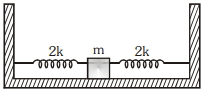
- 9Two identical springs of spring constant $'2k'$ are attached to a block of mass $m$ and to fixed support (see figure). When the mass is displaced from equilibrium position on either side, it executes simple harmonic motion. The time period of oscillations of this sytem is ...... .View Solution
- 10The bob of a pendulum was released from a horizontal position. The length of the pendulum is $10 \mathrm{~m}$. If it dissipates $10 \%$ of its initial energy against air resistance, the speed with which the bob arrives at the lowest point is : [Use, $\mathrm{g}: 10 \mathrm{~ms}^{-2}$ ]View Solution