Question
Two numbers are selected at random (without replacement) from the first five positive integers. Let X denote the larger of the two numbers obtained. Find the mean and variance of X.

Answer

The first five positive integers are 1, 2, 3, 4, 5 we select two positive numbers in 5 × 4 = 20 ways.
Out of these two no. are selected at random.
let X denote larger of the two no.
X can be 2, 3, 4 or 5.
P(X = 2) = P(larger no. is 2) = {(1, 2) and (2, 1)}
$=\frac{2}{30}$
$\text{P}(\text{X}=3)=\frac{4}{30}$
$\text{P}(\text{X}=4)=\frac{6}{30}$
$\text{P}(\text{X}=5)=\frac{8}{30}$
$\text{Mean}=\text{E}(\text{X})=2\times\frac{2}{30}+3\times\frac{4}{30}+4\times\frac{6}{30}+5\times\frac{8}{3 0}$
$=\frac{4+12+24+40}{30}$
$=\frac{80}{30}$
$\text{Variance}=2^2\times\frac{2}{30}+3^2\times\frac{4}{30}+4^2\times\frac{6}{30}+5^2\times\frac{8}{30}$
$=\frac{8+36+96+200}{30}$
$=\frac{340}{30}=\frac{34}{3}$

Need a full question paper?

Generate a complete, print-ready paper with questions like this in minutes — across 16+ boards, with answer keys.
Start Generating Free

Similar questions

Show that the points A, B, C with position vectors $2\hat{\text{i}} - \hat{\text{j}} + \hat{\text{k}}, \hat{\text{i}} - 3\hat{\text{j}} - 5\hat{\text{k}} \text{ and } 3\hat{\text{i}} - 4\hat{\text{j}} - 4\hat{\text{k}}$ respectively, are the vertices of a right-angled triangle. Hence find the area of the triangle.
Evaluate the following integrals:$\int\frac{(\text{x}-1)^2}{\text{x}^2+2\text{x}+2}\text{ dx}$
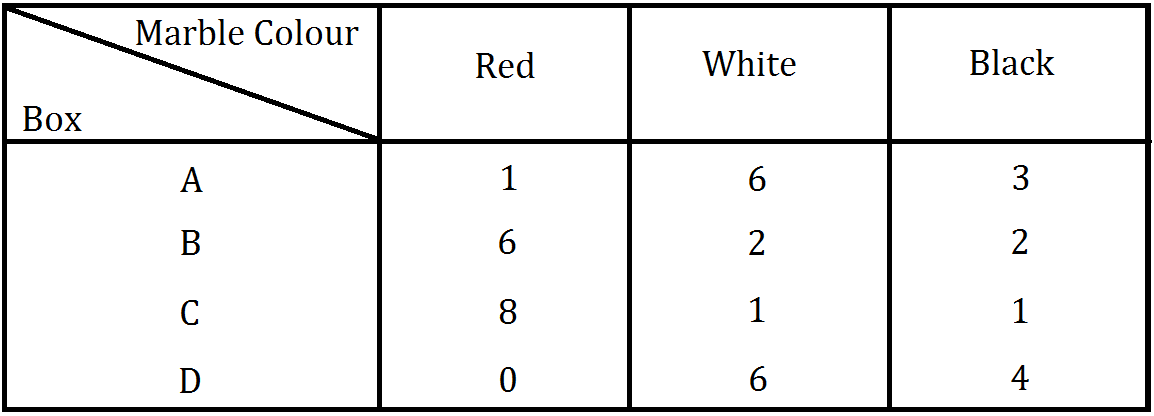
Suppose we have four boxes A, B, C, D containing coloured marbles as given below:
One of the boxes has been selected at random and a single marble is drawn from it. If the marble is red, what is the probability that it was drawn from,
  1. Box A?
  2. Box B?
  3. Box C?
Find the vector and Cartesian equations of the line through the point (1, 2, – 4) and perpendicular to the two lines.
$\overrightarrow{\text{r}} = (8\hat{\text{i}} - 19\hat{\text{j}} + 10\hat{\text{k}})+\lambda(3\hat{\text{i}} - 16\hat{\text{j}} + 7\hat{\text{k})}$ and $\overrightarrow{\text{r}} = (15\hat{\text{i}} - 29\hat{\text{j}} + 5\hat{\text{k}})+\mu(3\hat{\text{i}} - 8\hat{\text{j}} + 5\hat{\text{k})}.$
Solve the following differential equation:
$(1+\text{x}^2)\frac{\text{dy}}{\text{dx}}+\text{y}=\text{e}^{\tan^{-1}\text{x}}$
Form the differential equation of the family of circle in the secound qudrant and touching the coordinate axes.
Find the shortest distance between lines $\vec{\text{r}}=6\hat{\text{i}}+2\hat{\text{j}}+2\hat{\text{k}}+\lambda\Big(\hat{\text{i}}-2\hat{\text{j}}+2\hat{\text{k}}\Big)\ \text{and}\ \vec{\text{r}}=-4\hat{\text{i}}-\hat{\text{k}}+\mu\Big(3\hat{\text{i}}-2\hat{\text{j}}-2\hat{\text{k}}\Big).$
Find: $\int \bigg[\log (\log x) + \frac{1}{(\log x)^{2}}\bigg]dx$
Solve the following differential equations:$\cos\text{y}\frac{\text{dy}}{\text{dx}}=\text{e}^{\text{x}},\text{y}(0)=\frac{\pi}{2}$
Find the angle between the lines $\vec{\text{r}}=3\hat{\text{i}}-2{\hat{\text{j}}}+6\hat{\text{k}}+\lambda(2\hat{\text{i}}+{\hat{\text{j}}}+2\hat{\text{k}})$ and $\vec{\text{r}}=(2\hat{\text{i}}-5\hat{\text{k}})+\mu(6\hat{\text{i}}+3{\hat{\text{j}}}+2\hat{\text{k}}).$