MCQ
Two objects of equal masses placed at certain distance from each other attracts each other with a force of $F$. If one-third mass of one object is transferred to the other object, then the new force will be
  • A
    $\frac{2}{9}F$
  • B
    $\frac{16}{9}F$
  • $\frac{8}{9}F$
  • D
    $F$

Answer

Correct option: C.
$\frac{8}{9}F$
c
$F =\frac{ Gm ^{2}}{ r ^{2}}$

$F ^{\prime}=\frac{ G \left(\frac{4 m }{3}\right) \times\left(\frac{2 m }{3}\right)}{ r ^{2}}$

$F ^{\prime}=\frac{8}{9} F$

Need a full question paper?

Generate a complete, print-ready paper with questions like this in minutes — across 16+ boards, with answer keys.

Start Generating Free

Similar questions

A point moves in $x -y$ plane according to the law $x = 3\, cos\,4t$ and $y = 3\, (1 -sin\,4t)$. The distance travelled by the particle in $2\, sec$ is...........$m$  (where $x$ and $y$ are in $metres$ )
Two particles $A$ and $B$ are moving in uniform circular motion in concentric cirdes of radius $r_{A}$ and $r_{B}$ with speed $v_A$ and $v_B$ respectively. The time period of rotation is the same. The ratio of angular speed of $A$ to that of $B$ will be
A rod has length 3 m and its mass acting per unit length is directly proportional to distance x from one of its end, then its centre of gravity from that end will be at
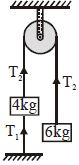
Two bodies of mass $4\,kg$ and $6\,kg$ are attached to the ends of a string passing over a pulley. A $4\,kg$ mass is attached to the table top by another string. The tension in this string $T_1$ is equal to ......... $N$
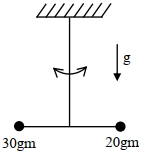
Two point-like objects of masses $20 \mathrm{gm}$ and $30 \mathrm{gm}$ are fixed at the two ends of a rigid massless rod of length $10 \mathrm{~cm}$. This system is suspended vertically from a rigid ceiling using a thin wire attached to its center of mass, as shown in the figure. The resulting torsional pendulum undergoes small oscillations. The torsional constant of the wire is $1.2 \times 10^{-8} \mathrm{~N} \mathrm{~m} \mathrm{rad}^{-1}$. The angular frequency of the oscillations is $n \times 10^{-3} \mathrm{rad} \mathrm{s}^{-1}$. The value of $n$ is
The value of restitution coefficient e for perfectly elastic collision is:
A vertical cylinder with heat-conducting walls is closed at the bottom and is fitted with a smooth light piston. It contains one mole of an ideal gas. The temperature of the gas is always equal to the surrounding’s temperature, $T_0$. The piston is moved up slowly to increase the volume of the gas to $\eta$ times. Which of the following is incorrect?
Three forces are acting simultaneously at one point. Two forces $\overrightarrow{ P }, \overrightarrow{ Q }$ are $(2 \hat{i}-3 \hat{j})$ and $(\hat{i}-\hat{j})$ respectively. If the object is in equilibrium then which will be the third:
A piece of ice (heat capacity $=2100 \mathrm{~J} \mathrm{~kg}^{-1}{ }^{\circ} \mathrm{C}^{-1}$ and latent heat $=3.36 \times 10^5 \mathrm{~J} \mathrm{~kg}^{-1}$ ) of mass $\mathrm{m}$ grams is at $-5^{\circ} \mathrm{C}$ at atmospheric pressure. It is given $420 \mathrm{~J}$ of heat so that the ice starts melting. Finally when the ice-water mixture is in equilibrium, it is found that $1 \ \mathrm{gm}$ of ice has melted. Assuming there is no other heat exchange in the process, the value of $m$ is
In Jager's method, at the time of bursting of the bubble