MCQ
Two parallel beams of electrons moving in the same direction produce a mutual force
  • A
    Of attraction in plane of paper
  • Of repulsion in plane of paper
  • C
    Upwards perpendicular to plane of paper
  • D
    Downwards perpendicular to plane of paper

Answer

Correct option: B.
Of repulsion in plane of paper
b
Two beams of electron moving parallel to each other in the same direction will repel each other in the plane of the paper.

Need a full question paper?

Generate a complete, print-ready paper with questions like this in minutes — across 16+ boards, with answer keys.
Start Generating Free

Similar questions

In a radioactive decay process , the negatively charged emitted $\beta -$ particles are
A satellite is launched into a circular orbit of radius $R$ around the earth. A second satellite is launched into an orbit of radius $(1.01)R$. The period of the second satellite is larger than that of the first one by approximately ........... $\%$
If $r_1$ and $r_2$ are the radii of the atomic nuclei of mass number $64$ and $125$ respectively, then the ratio $(r_1/r_2)$ is
A uniform chain of length $3\, meter$ and mass $3\, {kg}$ overhangs a smooth table with $2\, meter$ laying on the table. If $k$ is the kinetic energy of the chain in joule as it completely slips off the table, then the value of ${k}$ is (Take $\left.g=10\, {m} / {s}^{2}\right)$
The refractive index of a material of a prism of angles $45^o -45^o  -90^o $ is $1.5.$ The path of the ray of light incident normally on the hypotenuse side is shown in
The resistance of $1\, A$ ammeter is $0.018\,\Omega $. To convert it into $10\, A$ ammeter, the shunt resistance required will be
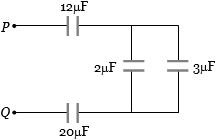
In the circuit diagram shown in the adjoining figure, the resultant capacitance between $P$ and $Q$ is........$\mu F$
A diverging lens with magnitude of focal length $25\ cm$ is placed at a distance of $15\ cm$ from a converging lens of magnitude of focal length $20\ cm$. A beam of parallel light falls on the diverging lens. The final image formed is
If a vector $2\hat i + 3\hat j + 8\hat k$ is perpendicular to the vector $4\hat j - 4\hat i + \alpha \hat k$. Then the value of $\alpha $ is
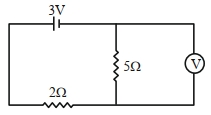
As shown in the figure, the voltmeter reads $2\,V$ across $5\,\Omega$ resistor. The resistance of the voltmeter is $.......\,\Omega$.