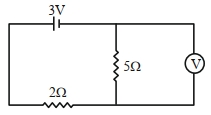
As shown in the figure, the voltmeter reads $2\,V$ across $5\,\Omega$ resistor. The resistance of the voltmeter is $.......\,\Omega$.
JEE MAIN 2023, Diffcult
Download our app for free and get started
$i_1=\frac{2\,V}{5\,\Omega}=\frac{2}{5}\,A$
$i=\frac{1 V}{2 \Omega}=\frac{1}{2}\,A$
$\therefore \text { Current through voltmeter }=i-i_1$
$=\frac{1}{2}-\frac{2}{5}=\frac{5-4}{10}=\frac{1}{10}\,A$
$\therefore \text { For voltmeter }$
$2=\left(\frac{1}{10}\right) R \Rightarrow R=20\,\Omega$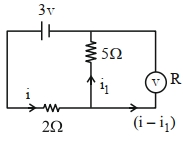

Download our appand get started for free
Experience the future of education. Simply download our apps or reach out to us for more information. Let's shape the future of learning together!No signup needed.*
Similar Questions
- 1$3$ identical bulbs are connected in series and these together dissipate a power $P$. If now the bulbs are connected in parallel, then the power dissipated will beView Solution
- 2Two resistors are connected $(a)$ in series $(b)$ in parallel. The equivalent resistance in the two cases are $9$ $ohm$ and $2$ $ohm$ respectively. Then the resistances of the component resistors areView Solution
- 3View SolutionTwo wires of the same material are given. The first wire is twice as long as the second and has twice the diameter of the second. The resistance of the first will be
- 4The resistance of a wire is $5\,ohm$ at $50\,^o C$ and $6\,ohm $ at $100\,^o C$. The resistance of the wire at $0\,^o C$ will be .............. $\Omega$View Solution
- 5The e.m.f. of a cell is $E\, volts$ and internal resistance is $r$ $ohm$. The resistance in external circuit is also $r$ $ohm$. The p.d. across the cell will beView Solution
- 6The specific resistance of manganin is $50 \times {10^{ - 8}}\,ohm \times m$. The resistance of a cube of length $50\,cm$ will beView Solution
- 7If three bulbs $60\,W$, $100\,W$ and $200\,W$ are connected in parallel, thenView Solution
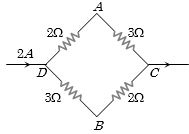
- 8A current of $2\,A$ flows in a system of conductors as shown. The potential difference $({V_A} - {V_B})$ will be ............ $V$View Solution
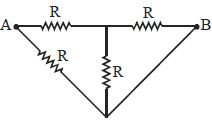
- 9Find equivalent resistance $A$ and $B$View Solution
- 10A potentiometer has uniform potential gradient. The specific resistance of the material of the potentiometer wire is $10^{-7} \, ohm-meter$ and the current passing through it is $0.1\, ampere$; cross-section of the wire is $10^{-6}\, m^2$. The potential gradient along the potentiometer wire isView Solution