MCQ
Two parallel large thin metal sheets have equal surface charge densities $(\sigma = 26.4 \times 10^{-12}\,c/m^2)$ of opposite signs. The electric field between these sheets is
  • A
    $1.5\,N/C$
  • B
    $1.5\times 10^{-10}\,N/C$
  • $3\,N/C$
  • D
    $3\times 10^{-10}\,N/C$

Answer

Correct option: C.
$3\,N/C$
c
Field between two parallel sheet

$ = \frac{\sigma }{{{ \in _0}}} = \frac{{26.4 \times {{10}^{ - 12}}}}{{8.85 \times {{10}^{ - 12}}}} = 3\,N/C$

Need a full question paper?

Generate a complete, print-ready paper with questions like this in minutes — across 16+ boards, with answer keys.

Start Generating Free

Similar questions

Radius of first Bohr orbit is $r$. What is the radius of $2^{nd}$ Bohr orbit $ ?$
$A$ fish is near the centre of a spherical water filled $( \mu = 4/3)$ fish bowl. $A$ child stands in air at a distance $2R$ ($R$ is the radius of curvature of the sphere) from the centre of the bowl. At what distance from the centre would the child nose appear to the fish situated at the centre :
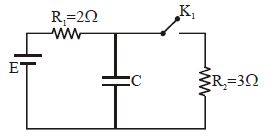
In the circuit shown in the figure $K_1$ is open. The charge on capacitor $C$ in steady state is $q_1$. Now key is closed and at steady state charge on $C$ is $q_2$. The ratio of charges $q_1/q_2$ is
When half of a lens is wrapped in a black cloth, what will be the effect on the image formed by the lens?
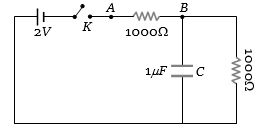
When the key $K$ is pressed at time $t = 0$, which of the following statements about the current $I$ in the resistor $AB$ of the given circuit is true
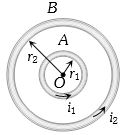
$A$ and $B$ are two concentric circular conductors of centre $O$ and carrying currents ${i_1}$ and ${i_2}$ as shown in the adjacent figure. If ratio of their radii is $1 : 2$ and ratio of the flux densities at $O$ due to $A$ and $B$ is $1 : 3$, then the value of ${i_1}/{i_2}$ is
Consider the following two equations :
$\text{L}=\text{I}\omega$
$\frac{\text{dL}}{\text{dt}}=\Gamma$
In noninertial frames :
The addition of antimony atoms to a sample of intrinsic germanium transforms it to a material which is
In a photon$-$particle collision, the quantity that does not remain conserved is:
In the visible region the dispersive powers and the mean angular deviations for crown and flint glass prisms are $\omega , \omega '$ and $d, d' $ respectively. The condition for getting deviation without dispersion when the two prisms are combined is