Question
Two parallel lines $l$ and $m$ are intersected by a transversal $p$. Show that the quadrilateral formed by the bisectors of interior angles is a rectangle.
Answer


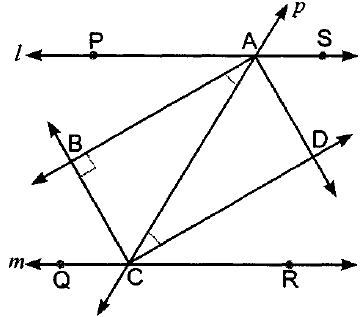
Here, it is given that $QR \parallel PS$ and transversal $p$ intersects them at points $A$ and $C$ respectively.
The bisectors of $\angle ACR$ and $\angle SAC$ intersect at $D$ and the bisectors of $\angle PAC$ and $\angle ACQ$ intersect at $B.$
We have to prove that quadrilateral$\text{ABCD}$ is a rectangle.
From the given figure, we have
$\angle PAC = \angle ACR [$Alternate angles as $l \parallel m$ and $p$ is a transversal$]$
So, $\frac{1}{2} \angle PAC = \frac{1}{2} \angle ACR$
i.e., $\angle BAC = \angle ACD$
These form a pair of alternate angles for lines $AB$ and $DC$ with $AC$ as a transversal and they are equal also.
So$, AB \parallel DC$
Similarly $, BC \parallel AD [$Considering $\angle ACB$ and $\angle CAD]$
Therefore, quadrilateral $\text{ABCD}$ is a parallelogram
Also, $\angle PAC + \angle CAS = 180^\circ [$ by the property of Linear pair$]$
So, $\frac{1}{2} \angle PAC + \frac{1}{2} \angle CAS = \frac{1}{2} \times 180^\circ = 90^\circ$
or, $\angle BAC + \angle CAD = 90^\circ$
or, $\angle BAD = 90^\circ$
So, $\text{ABCD}$ is parallelogram in which one angle $(\angle BAD )$ is $90^\circ$.
Therefore, $\text{ABCD}$ is a rectangle.

Need a full question paper?

Generate a complete, print-ready paper with questions like this in minutes — across 16+ boards, with answer keys.
Start Generating Free

Similar questions

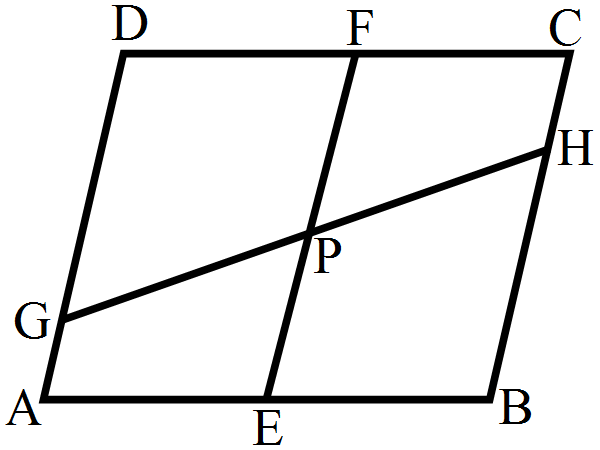
In the adjoining figure, ABCD is a || gm in which E and F are the midpoints of AB and CDrespectively. If GH is a line segment that cuts AD, EF and BC at G, P and H respectively, prove that GP = PH.
Draw the graph of the equation, 2x + y = 6.
Find the coordinates of the point where the graph cuts the x-axis.
Two parallel chords of lengths $30\ cm$ and $16\ cm$ are drawn on the opposite sides of the centre of a circle of radius $17\ cm.$ Find the distance between the chords.
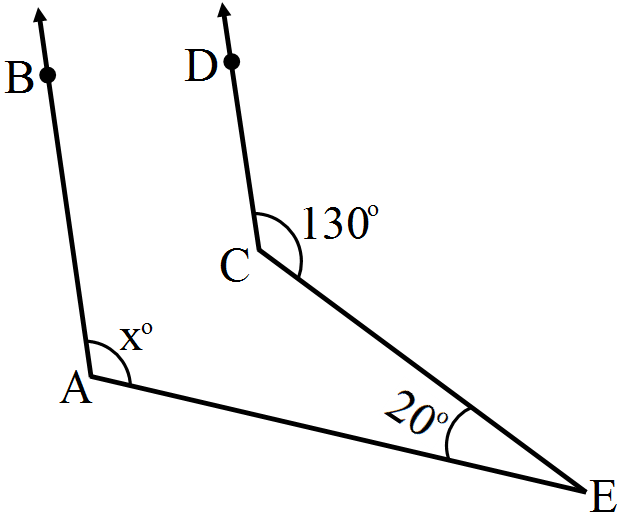
In the given figure, AB || CD. Find the value of x.
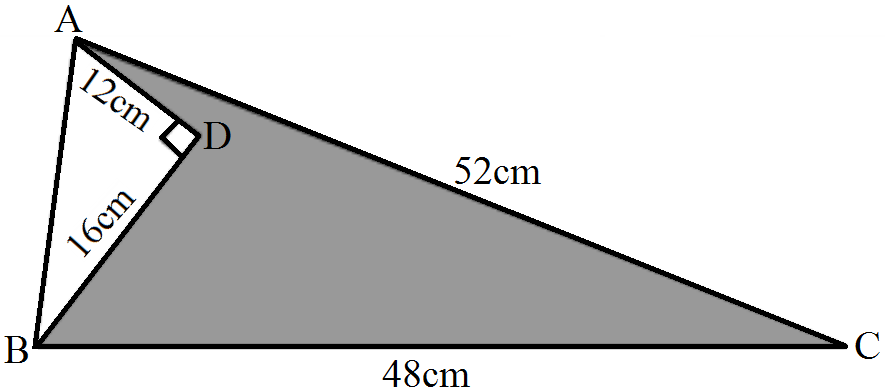
Find the area of the shaded region in the figure given below.
A rhombus$-$shaped sheet with perimeter $40\ cm$ and one diagonal $12\ cm,$ is painted on both sides at the rate of $₹\ 5$ per $\ cm^2.$ Find the cost of painting.
The following data gives the amount of manure (in thousand tonnes) manufactured by a company during some years:
Year
1992
1993
1994
1995
1996
1997
Manure (in thousand tonnes)
15
35
45
30
40
20
  1. Represent the above data with the help of a bar graph.
  2. Indicate with the help of the bar graph the year in which the amount of manufactured by the company was maximum.
  3. Choose the correct alternative:
The consecutive years during which there was the maximum decrease in manure production are:
  1. 1994 and 1995
  2. 1992 and 1993
  3. 1996 and 1997
  4. 1995 and 1996
$(x + y)^3 - (x - y)^3$ can be factorized as:
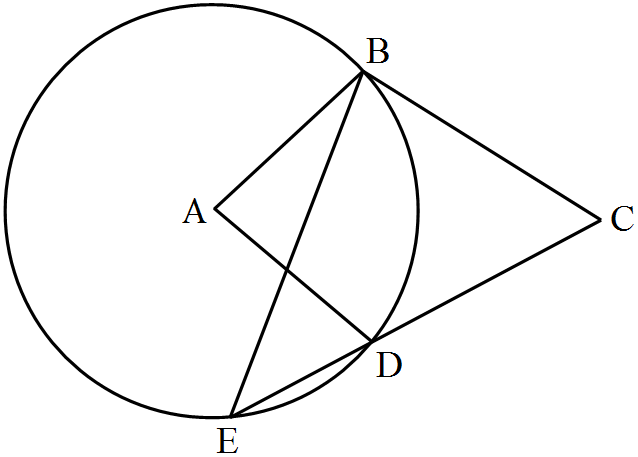
In the given figure, A is the centre of the circle. ABCD is a parallelogram and CDE is a straight line. Find $\angle\text{BCD}:\angle\text{ABE}.$
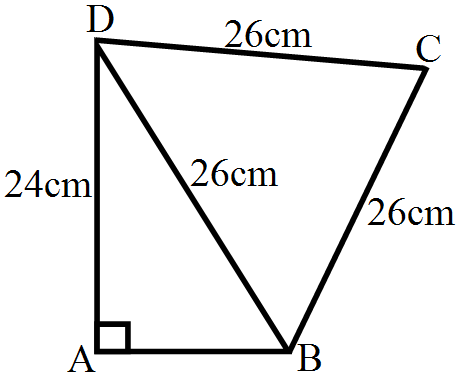
Find the perimeter and area of a qudrilateral ABCD in which BCD is an equilateral triangle, each of whose sides is 26cm, AD = 24cm and $\angle\text{BAD}=90^\circ.$ Also, find the perimeter of the quadrilateral. $\big(\text{Given},\sqrt{3}=1.73.\big)$