Question
Two particles A and B having charges q and 2q respectively are placed on a smooth table with a separation d. A third particle C is to be clamped on the table in such a way that the particles A and B remain at rest on the table under electrical forces. What should be the charge on C and where should it be clamped?
Answer


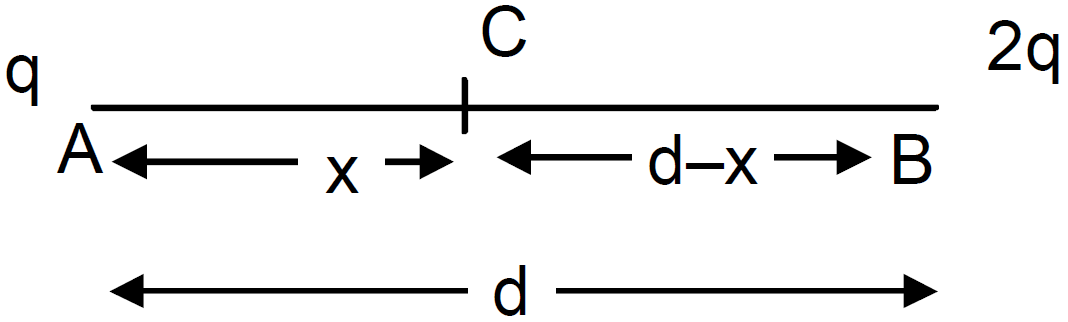
Let the charge on C = q
So, net force on c is equal to zero
So, $\text{F}_{\overline{\text{AC}}}+\text{F}_{\overline{\text{BA}}}=0,$
But $\text{F}_{\overline{\text{AC}}}=\text{F}_{\overline{\text{BC}}}$
$\Rightarrow\frac{\text{kqQ}}{\text{x}^2}=\frac{\text{k}2\text{qQ}}{(\text{d}-\text{x})^2}$
$\Rightarrow2\text{x}^2=(\text{d}-\text{x})^2$
$\Rightarrow\sqrt{2}\text{x}=\text{d}-\text{x}$
$\Rightarrow\text{x}=\frac{\text{d}}{\sqrt{2}+1}$
$=\frac{\text{d}}{\big(\sqrt{2}+1\big)}\times\frac{\big(\sqrt{2}-1\big)}{\big(\sqrt{2}-1\big)}$
$=\text{d}\big(\sqrt{2}-1\big)$
For the charge on rest, $\text{F}_\text{AC}+\text{F}_\text{AB}=0$
$(2.414)^2\frac{\text{kqQ}}{\text{d}^2}+\frac{\text{kq}(2\text{q})}{\text{d}^2}=0$
$\Rightarrow\frac{\text{kq}}{\text{d}^2}\big[(2.414)^2\text{Q}+2\text{q}\big]=0$
$\Rightarrow2\text{q}=-(2.414)^2\text{Q}$
$\Rightarrow\text{Q}=\frac{2}{-\big(\sqrt{2}+1\big)^2}\text{q}$
$=-\Big(\frac{2}{3+2\sqrt{2}}\Big)\text{q}$
$=-(0.343)\text{q}$
$=-\big(6-4\sqrt{2}\big)$

Need a full question paper?

Generate a complete, print-ready paper with questions like this in minutes — across 16+ boards, with answer keys.

Start Generating Free

Similar questions

A bulb with rating 250V, 100W is connected to a power supply of 220V situated 10m away using a copper wire of area of cross-section $5mm^2.$ How much power will be consumed by the connecting wires? Resistivity of copper $1.7\times10^{-8}\Omega-\text{m}$.
Two particles A and B of de Broglie wavelengths $\lambda _1$ and $\lambda _2$ combine to form a particle C. The process conserves momentum. Find the de Broglie wavelength of the particle C. (The motion is one dimensional).
A source of sound emitting a 1200Hz note travelg along a straight line at a speed of 170m/s. A detector is placed at a distance of 200m from the line of motion of the source.
  1. Find the frequency of sound received by the detector at the instant when the source gets closest to it.
  2. Find the distance between the source and the detector at the instant it detects the frequency 1200Hz. Velocity of sound in air = 340m/s.
Consider the situation shown in figure. The elevator is going up with an acceleration of $2.00m/s^2$ and the focal length of the mirror is 12.0cm. All the surfaces are smooth and the pulley is light. The mass-pulley system is released from rest (with respect to the elevator) at t = 0 when the distance of B from the mirror is 42.0cm. Find the distance between the image of the block B and the mirror at t = 0.200s. Take $g = 10m/s^2.$​​​​​​​
A projectile is fired with a speed u at an angle $\theta$ above a horizontal field. The coefficient of restitution of collision between the projectile and the field is e. How far from the starting point, does the projectile makes its second collision with the field?
Two conductors are made of the same material and have the same length. Conductor A is a solid wire of diameter 1mm. Conductor B is a hollow tube of outer diameter 2mm and inner diameter 1mm. Find the ratio of resistance $R_A$ to $R_B.$
  1. Draw a ray diagram showing the image formation by a compound microscope. Hence obtain expression for total magnification when the image is formed at infinity.
  2. Distinguish between myopia and hypermetropia. Show diagrammatically how these defects can be corrected.
A source emitting sound at frequency 4000Hz, is moving along the Y-axis with a speed of 22m/s. A listener is situated on the ground at the position (660m, 0). Find the frequency of the sound received by the listener at the instant the source the origin. Speed of sound in air = 330m/s.
A radio can tune in to any station in the 7.5 MHz to 12 MHz band. What is the corresponding wavelength band?
Consider the situation of the previous problem:
  1. Find the tension in the string in equilibrium.
  2. Suppose the ball is slightly pushed aside and released. Find the time period of the small oscillations.