MCQ
Two particles of equal mass $\mathrm{m}$ have respective initial velocities $u\hat{i}$ and $u\left(\frac{\hat{\mathrm{i}}+ \hat{\mathrm{j}}}{2}\right) .$ They collide completely inelastically. The energy lost in the process is
  • A
    $\frac{3}{4} \mathrm{mu}^{2}$
  • $\frac{1}{8} \mathrm{mu}^{2}$
  • C
    $\sqrt{\frac{2}{3}} \mathrm{mu}^{2}$
  • D
    $\frac{1}{3} \mathrm{mu}^{2}$

Answer

Correct option: B.
$\frac{1}{8} \mathrm{mu}^{2}$
b
From momentum conservation

$\operatorname{mu\hat{i}}+\operatorname{mu}\left(\frac{\hat{\mathrm{i}}+\hat{\mathrm{j}}}{2}\right)=(\mathrm{m}+\mathrm{m}) \overline{\mathrm{v}}$

$\Rightarrow \overline{\mathrm{v}}=\frac{3}{4} \mathrm{u} \hat{\mathrm{i}}+\frac{\mathrm{u}}{4} \hat{\mathrm{j}}$

$\Rightarrow|\mathrm{v}|=\frac{\mathrm{u}}{4} \sqrt{10}$

Final kinetic energy $=\frac{1}{2} 2 \mathrm{m}\left(\frac{\mathrm{u}}{4} \sqrt{10}\right)^{2}=\frac{5}{8} \mathrm{mu}^{2}$

Initial kinetic energy

$=\frac{1}{2} \mathrm{mu}^{2}+\frac{1}{2} \mathrm{m}\left(\frac{\mathrm{u}}{\sqrt{2}}\right)^{2}=\frac{6}{8} \mathrm{mu}^{2}$

Loss in $\mathrm{K.E.}=\mathrm{k}_{\mathrm{i}}-\mathrm{k}_{\mathrm{f}}=\frac{1}{8} \mathrm{mu}^{2}$
Need a full question paper?

Generate a complete, print-ready paper with questions like this in minutes — across 16+ boards, with answer keys.

Start Generating Free

Similar questions

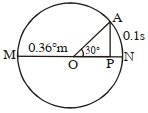
The point $A$ moves with a uniform speed along the circumference of a circle of radius $0.36\, m$ and covers $30^{\circ}$ in $0.1\, s$. The perpendicular projection $'P'$ from $'A'$ on the diameter $MN$ represents the simple harmonic motion of $'P'.$ The restoration force per unit mass when $P$ touches $M$ will be ...... $N$
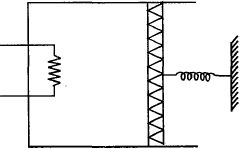
An ideal monoatomic gas is confined in a cylinder by a spring loaded piston of cross section $8.0\times10^{-3}\, m^2$ . Initially the gas is at $300\, K$ and occupies a volume of $2.4\times10^{-3}\, m^3$ and the spring is in its relaxed state as shown in figure. The gas is heated by a small heater until the piston moves out slowly by $0.1\, m$. The force constant of the spring is $8000\, N/m$ and the atmospheric pressure is $1.0\times10^5\, N/m^2$ . The cylinder and the piston are thermally insulated. The piston and the spring are massless and there is no friction between the piston and the cylinder. The final temperature of the gas will be: (Neglect the heat loss through the lead wires of the heater . The heat capacity of the heater coil is also negligible)
A black body radiates $ 20\,W$ at temperature ${227^o}C$. If temperature of the black body is changed to ${727^o}C$ then its radiating power will be ..... $W$
A body $A$ starts from rest with an acceleration ${a_1}$. After $2$ seconds, another body $B$ starts from rest with an acceleration ${a_2}$. If they travel equal distances in the $5$th second, after the start of $A$, then the ratio ${a_1}:{a_2}$ is equal to
A stone is projected at angle $30^{\circ}$ to the horizontal. The ratio of kinetic energy of the stone at point of projection to its kinetic energy at the highest point of flight will be :
A gas bubble from an explosion under water oscillates with a period proportional of $P^a\,d^b\,E^c$ where $P$ is the static pressure, $d$ is the density of water and $E$ is the energy of explosion. Then $a,\,b$ and $c$ are
A solid cylinder $P$ rolls without slipping from rest down an inclined plane attaining a speed $v_p$ at the bottom. Another smooth solid cylinder $Q$ of same mass and dimensions slides without friction from rest down the inclined plane attaining a speed $v_q$ at the bottom. The ratio of the speeds $\frac{v_q}{v_p}$ is
Two rigid boxes containing different ideal gases are placed on a table. Box A contains one mole of nitrogen at temperature $T_0$, while Box contains one mole of helium at temperature $(7/3)$ $T_0$ The boxes are then put into thermal contact with each other, and heat flows between them until the gases reach a common final temperature (ignore the heat capacity of boxes). Then, the final temperature of the gases,$T_f$  in terms of $T_0$ is
The given quantity of an ideal gas is at pressure $P$ and absolute Temperature $T.$ The isothermal bulk Modulus of the gas is:
Mean kinetic energy (or average energy) per gm molecule of a monoatomic gas is given by