Question

Two particles X and Y having equal charges, after being accelerated through the same potential difference, enter a region of uniform magnetic field and describes circular path of radius   and  respectively. The ratio of mass of X to that of Y is

(a)

(b)  

(c)

(d)

Answer

(c)

Need a full question paper?

Generate a complete, print-ready paper with questions like this in minutes — across 16+ boards, with answer keys.

Start Generating Free

Similar questions

The wiring of a house has resistance 6 A 100 W bulb is glowing. If a geyser of 1000 W is switched on, the change in potential drop across the bulb is nearly

(a) Nil

(b) 23 V

(c) 32 V   

(d) 12 V

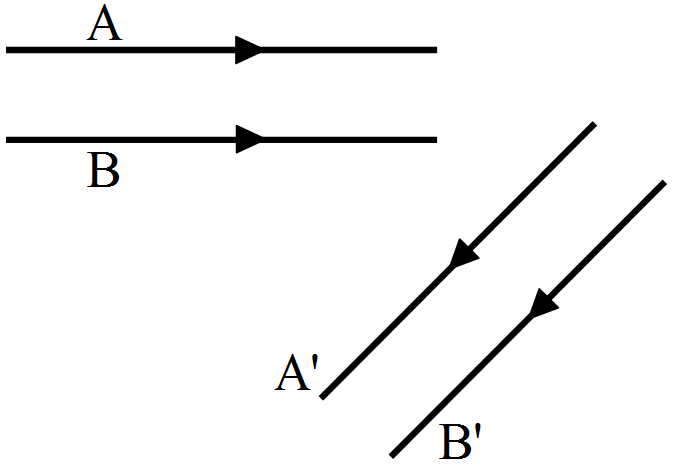
Two rays A and B being reflected by a mirror and going as A' and B'. The mirror:

If two streams of protons move parallel to each other in the same direction, then they

(a) Do not exert any force on each other

(b) Repel each other

(c) Attract each other

(d) Get rotated to be perpendicular to each other

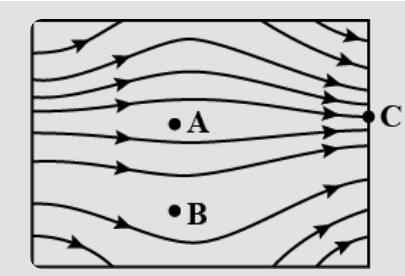
Figure shows the magnetic field lines in a magnetic field. A, B. and C are three points in this field. At what point is the magnetic field strong ?

A person cannot see objects clearly beyond 2.0 m. The power of lens required to correct his vision will be

(a) + 2.0 D

(b) – 1.0 D

(c) + 1.0 D

(d) – 0.5 D

It is desired to photograph the image of an object placed at a distance of 3m from the plane mirror. The camera which is at a distance of 4.5 m  from the mirror should be focussed for a distance of

(a) 3m

(b) 4.5m

(c) 6m

(d) 7.5 m

what is the potential difference between two points, if 2J of work must be done to move a 4 mC charge from one point to another is:

The maximum current that flows through a fuse wire before it blows out varies with its radius as

(a)  

(b) r

(c)  

(d)  

A 4 mF capacitor, a resistance of 2.5 MW is in series with 12 V battery. Find the time after which the potential difference across the capacitor is 3 times the potential difference across the resistor. [Given ln(2)= 0.693]

(a) 13.86 s

(b) 6.93 s

(c) 7 s      

(d) 14 s

A gas is contained in a metallic cylinder fitted with a piston. The piston is suddenly moved in to compress the gas and is maintained at this position. As time passes the pressure of the gas in the cylinder:
  1. Increases.
  2. Decreases.
  3. Remains constant.
  4. Increases or decreases depending on the nature of the gas.