MCQ
Two $PN-$junctions can be connected in series by three different methods as shown in the figure. If the potential difference in the junctions is the same, then the correct connections will be
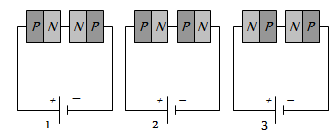
  • A
    In the circuit $(1)$ and $(2)$
  • In the circuit $(2)$ and $(3)$
  • C
    In the circuit $(1)$ and $(3)$
  • D
    Only in the circuit $(1)$

Answer

Correct option: B.
In the circuit $(2)$ and $(3)$

Need a full question paper?

Generate a complete, print-ready paper with questions like this in minutes — across 16+ boards, with answer keys.

Start Generating Free

Similar questions

Magnitude of produced magnetic field at any point inside a solenoid depends on:
Kirchhoff's second law in any closed circuit represents:
For a colour of light the wavelength for air is $6000 \mathring A$ and in water the wavelength is $4500 \mathring A .$ Then the speed of light in water will be
Huygens' principle of secondary wavelets may be used to:
  1. Find the velocity of light in vacuum.
  2. Explain the particle behaviour of light.
  3. Find the new position of a wavefront.
  4. Explain Snell's law.
The work done by the external force in bringing the charge q from infinity to a point is called as:
A thermo couple is formed by two metals X and Y metal X comes earlier to Y in Seebeck series. If temperature of hot junction increases beyond the temperature of inversion. Then direction of current in thermocouple will so(a) X to Y through cold junction(b) X to Y through hot junction(c) Y to X through cold junction(d) Both (b) and (c)
   
   
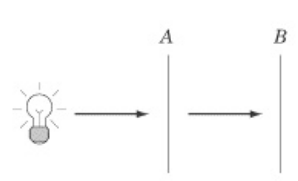
A person shines a coherent light of a bulb through an object, A, which produces a pattern of concentric rings on a screen, B. A is most likely:
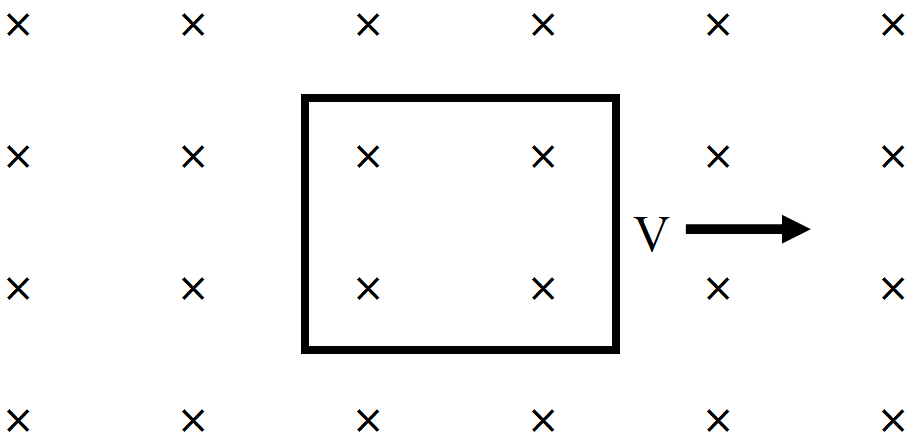
A conducting square loop of side l and resistance R moves in its plane with a uniform velocity u perpendicular to one of its sides. A uniform and constant magnetic field B exists along the perpendicular to the plane of the loop as shown in figure. The current induced in the loop is:
  1. $\frac{\text{Blv}}{\text{R}}$ clockwise.
  2. $\frac{\text{Blv}}{\text{R}}$ anticlockwise.
  3. $\frac{2\text{Blv}}{\text{R}}$ anticlockwise.
  4. $\text{Zero.}$
The depletion region of a $P - N$ junction consists of :
The focal length of the objective of a compound microscope is: