MCQ
Two projectiles are thrown simultaneously in the same plane from the same point. If their velocities are $v_1$ and $v_2$ at angles $\theta _1$ and $\theta_2$ respectively from the horizontal, then answer the following question

If $v_1\,\,cos\,\,\theta _1 = v_2\,\,cos\,\,\theta _2$, then choose the incorrect statement

  • A
    one particle will remain exactly below or above the other particle
  • B
    the trajectory of one with respect to other will be a vertical straight line
  • both will have the same range
  • D
    none of these

Answer

Correct option: C.
both will have the same range
c

Need a full question paper?

Generate a complete, print-ready paper with questions like this in minutes — across 16+ boards, with answer keys.

Start Generating Free

Similar questions

A force $\overrightarrow F = - K(y\hat i + x\hat j)$ (where $K$ is a positive constant) acts on a particle moving in the $x-y$ plane. Starting from the origin, the particle is taken along the positive $x-$ axis to the point $(a, 0)$ and then parallel to the $y-$axis to the point $(a, a)$. The total work done by the forces $\overrightarrow F $ on the particle is
The internal energy of an ideal gas is in the form of:
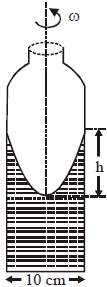
A cylindrical vessel containing a liquid is rotated about its axis so that the liquid rises at its sides as shown in the figure. The radius of vessel is $5\, cm$ and the angular speed of rotation is  $\omega\; rad \,s^{-1}$. The difference in the height, $h($ in $cm )$ of liquid at the centre of vessel and at the side will be
A thermally insulated vessel contains an ideal gas of molecular mass $M$ and ratio of specific heats $1.4$. Vessel is moving with speed $v$ and is suddenly brought to rest. Assuming no heat is lost to the surrounding and vessel temperature of the gas increases by ... ( $R =$ universal gas constant )
$Assertion$ : If a body is thrown upwards, the distance covered by it in the last second of upward motion is about $5\, m$ irrespective of its initial speed
$Reason$ : The distance covered in the last second of upward motion is equal to that covered in the first second of downward motion when the particle is dropped.
A body, thrown upwards with some velocity reaches the maximum height of $50 \,m$. Another body with double the mass thrown up with double the initial velocity will reach a maximum height of............$m$
If a cycle wheel of radius $4 \,m$ completes one revolution in two seconds. Then acceleration of a point on the cycle wheel will be
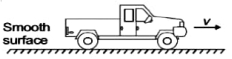
A cart loaded with sand moving with velocity $v$. Sand is falling through the hole as shown in diagram then after falling on the ground sand is
Two identical satellites are at $R$ and $7R$ away from earth surface, the wrong statement is ($R $ = Radius of earth)
Consider $1 \,kg$ of liquid water undergoing change in phase to water vapour at $100^{\circ} C$. At $100^{\circ} C$, the vapour pressure is $1.01 \times 10^5 \,N - m ^2$ and the latent heat of vaporization is $22.6 \times 10^5 \,Jkg ^{-1}$. The density of liquid water is $10^3 \,kg m ^{-3}$ and that of vapour is $\frac{1}{1.8} \,kg m ^{-3}$. The change in internal energy in this phase change is nearly ............ $\,J kg ^{-1}$