Question
Two protons and two electrons are hanging freely at equal distances. Compare the repulsion force between proton and electron.

Answer

The repulsion forces between two protons and two electrons will be equal because the magnitude of charge on the proton and electron is equal and the distances between them are also equal.

Need a full question paper?

Generate a complete, print-ready paper with questions like this in minutes — across 16+ boards, with answer keys.
Start Generating Free

Similar questions

A circular coil of radius 2.0cm has 500 turns and carries a current of 1.0A. Its axis makes an angle of 30° with the uniform magnetic field of magnitude 0.40 T that exists in the space. Find the torque acting on the coil.
A man of mass 50kg starts moving on the earth and acquires a speed of 1.8m/s. With what speed does the earth recoil? Mass of earth = 6 × 1024kg.
The magnetic field inside a tightly wound, long solenoid is $\text{B}=\mu_0\text{ni}.$ It suggests that the field does not depend on the total length of the solenoid, and hence if we add more loops at the ends of a solenoid the field should not increase. Explain qualitatively why the extra-added loops do not have a considerable effect on the field inside the solenoid.
Two electric bulbs P and Q have their resistances in the ratio of 1 : 2. They are connected in series across a battery. Find the ratio of the power dissipation in these bulbs.
The fission properties of ${ }_{94}^{239} Pu$ are very similar to those of ${ }_{92}^{235} U$. The average energy released per fission is 180 MeV . How much energy, in MeV, is released if all the atoms in 1 kg of pure ${ }_{94}^{239} Pu$ undergo fission?
In Exercises 7.3 and 7.4, what is the net power absorbed by each circuit over a complete cycle. Explain your answer.
An alpha particle is projected vertically upward with a speed of 3.0 × 10⁴km s-1 in a region where a magnetic field of magnitude 1.0T exists in the direction south to north. Find the magnetic force that acts on the α-particle.
Write a short note on 'Valves' in electronics.
Free electron density of copper is $8.5 \times 10^{28}$ per $m ^3$. Find out the current in copper wire of length 0.1 m and area of cross-section $1 mm^2$ when a battery of 3 V is joined across its ends. (Given mobility of electrons = $4.5 \times 10^{-6} m^2 V^{-1} s^{-1}$, charge on electron, $e=1.6 \times 10^{-19} C$ )
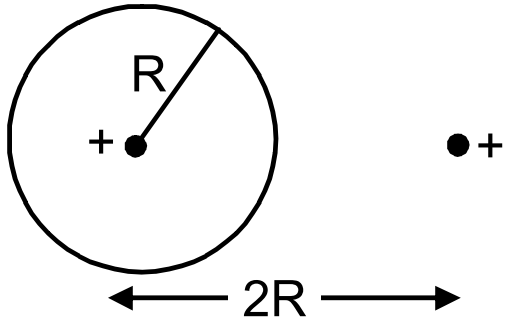
Find the flux of the electric field through a spherical surface of radius R due to a charge of 10-7C at the centre and another equal charge at a point 2R away from the centre.