MCQ
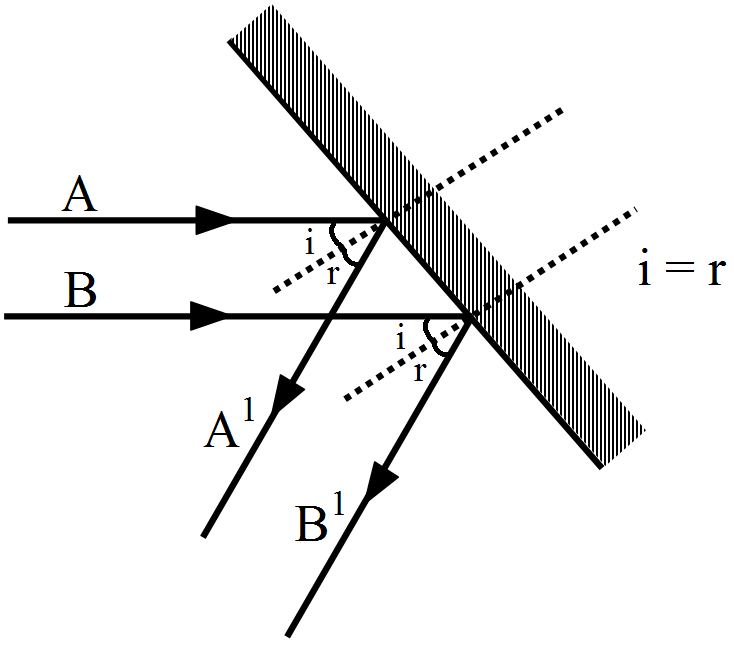
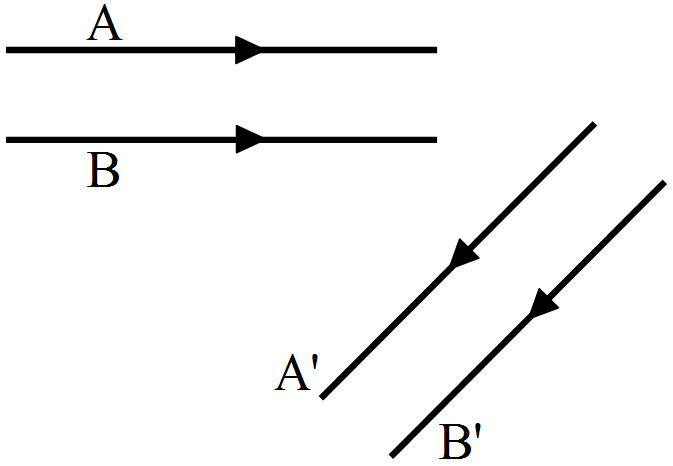
Two rays A and B being reflected by a mirror and going as A' and B'. The mirror:
  • Is plane.
  • B
    Is convex.
  • C
    Is concave.
  • D
    May be any spherical mirror.

Answer

Correct option: A.
Is plane.


Here initially A & B is parallel to each other after reflection by teh plane mirror A' & B' goes Parallel to each other.

Need a full question paper?

Generate a complete, print-ready paper with questions like this in minutes — across 16+ boards, with answer keys.
Start Generating Free

Similar questions

A frictionless pulley is attached to one arm of a balance and a string passed around it carries two masses $m_1$ and $m_2$. The pulley is provided with $a$ clamp due to which $m_1$ and $m_2$ do not move $w.r.t.$ each other. On removing the clamp, if the counter mass restores balance, then acceleration of centre of mass of the masses $m_1$ and $m_2$ will have acceleration of magnitude ? 
A sphere of mass $m$ and radius $R$ is kept on arough horizontal surface and pulled with a horizontal force $F = \alpha\ t$ where $\alpha$  is a constant and $t$ is time. The coefficient of static friction is $μ_s$ and coefficient of kinetic friction is $μ_k$ . Which of the following graph correctly shows the variation of acceleration of sphere with time ?
Latent heat of $1\,gm $ of steam is $536 \,cal/gm,$ then its value in $joule/kg$ is
A body of mass $5\, kg$ moving with a velocity $10\,m/s$ collides with another body of the mass $20 \,kg$ at, rest and comes to rest. The velocity of the second body due to collision is ......... $m/s$
If the measurement errors in all the independent quantities are known, then it is possible to determine the error in any dependent quantity. This is done by the use of series expansion and truncating the expansion at the first power of the error. For example, consider the relation $z=x / y$. If the errors in $x, y$ and $z$ are $\Delta x, \Delta y$ and $\Delta z$, respectively, then

$\mathrm{z} \pm \Delta \mathrm{z}=\frac{\mathrm{x} \pm \Delta \mathrm{x}}{\mathrm{y} \pm \Delta \mathrm{y}}=\frac{\mathrm{x}}{\mathrm{y}}\left(1 \pm \frac{\Delta \mathrm{x}}{\mathrm{x}}\right)\left(1 \pm \frac{\Delta \mathrm{y}}{\mathrm{y}}\right)^{-1} .$

The series expansion for $\left(1 \pm \frac{\Delta y}{y}\right)^{-1}$, to first power in $\Delta y / y$, is $1 \mp(\Delta y / y)$. The relative errors in independent variables are always added. So the error in $\mathrm{z}$ will be $\Delta \mathrm{z}=\mathrm{z}\left(\frac{\Delta \mathrm{x}}{\mathrm{x}}+\frac{\Delta \mathrm{y}}{\mathrm{y}}\right)$.

The above derivation makes the assumption that $\Delta x / x<<1, \Delta \mathrm{y} / \mathrm{y} \ll<1$. Therefore, the higher powers of these quantities are neglected.

($1$) Consider the ratio $\mathrm{r}=\frac{(1-\mathrm{a})}{(1+\mathrm{a})}$ to be determined by measuring a dimensionless quantity a.

If the error in the measurement of $\mathrm{a}$ is $\Delta \mathrm{a}(\Delta \mathrm{a} / \mathrm{a} \ll<1)$, then what is the error $\Delta \mathrm{r}$ in

$(A)$ $\frac{\Delta \mathrm{a}}{(1+\mathrm{a})^2}$ $(B)$ $\frac{2 \Delta \mathrm{a}}{(1+\mathrm{a})^2}$ $(C)$ $\frac{2 \Delta \mathrm{a}}{\left(1-\mathrm{a}^2\right)}$ $(D)$ $\frac{2 \mathrm{a} \Delta \mathrm{a}}{\left(1-\mathrm{a}^2\right)}$

($2$) In an experiment the initial number of radioactive nuclei is $3000$ . It is found that $1000 \pm$ $40$ nuclei decayed in the first $1.0 \mathrm{~s}$. For $|\mathrm{x}| \ll 1$, In $(1+\mathrm{x})=\mathrm{x}$ up to first power in $x$. The error $\Delta \lambda$, in the determination of the decay constant $\lambda$, in $\mathrm{s}^{-1}$, is

$(A) 0.04$    $(B) 0.03$    $(C) 0.02$   $(D) 0.01$

Give the answer quetion ($1$) and ($2$)

Two rectangular blocks $A$ and $B$ of different metals have same length and same area of cross-section. They are kept in such a way that their cross-sectional area touch each other. The temperature at one end of $A$ is $100°C$ and that of $B$ at the other end is $0°C$ . If the ratio of their thermal conductivity is $1 : 3$ , then under steady state, the temperature of the junction in contact will be ........ $^oC$
Match List$-I$ with List$-II$

List$-I$ List$-II$
$(a)$ Isothermal $(i)$ Pressure constant
$(b)$ Isochoric $(ii)$ Temperature constant
$(c)$ Adiabatic $(iii)$ Volume constant
$(d)$ Isobaric $(iv)$ Heat content is constant

Choose the correct answer from the options given below
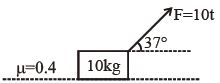
A force acts on a block as shown in figure. Find time when block loses contact with surface.
Two masses $m_1$ and $m_2$ ($m_1$ > $m_2$) are connected by massless flexible and inextensible string passed over massless and frictionless pulley. The acceleration of center of mass is
An $AC$ source producing emf $\in=\in_{0}\Big[\cos\big(100\pi\text{s}^{-1}\big)\text{t}+\cos\big(500\pi\text{s}^{-1}\big)\text{t}\Big]$ is connected in series with a capacitor and a resistor. The steady$-$state current in the circuit is found to be $\text{i}=\text{i}_1\cos\Big[\big(100\pi\text{s}^{-1}\big)\text{t}+\phi_1\Big]+\text{i}_2\cos\Big[\big(500\pi\text{s}^{-1}\big)\text{t}+\phi_2\Big].$