Question
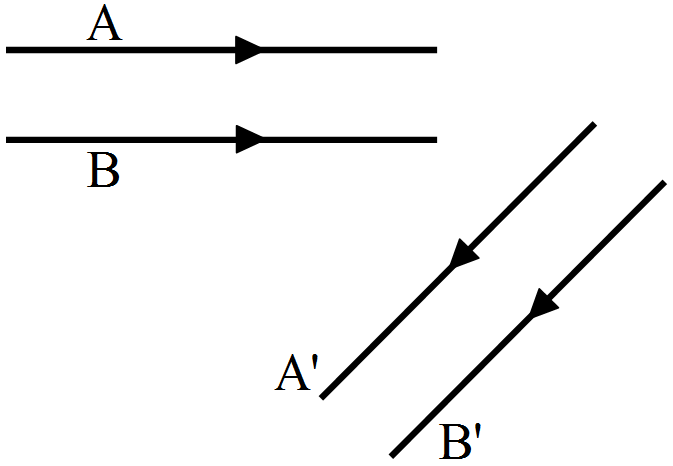
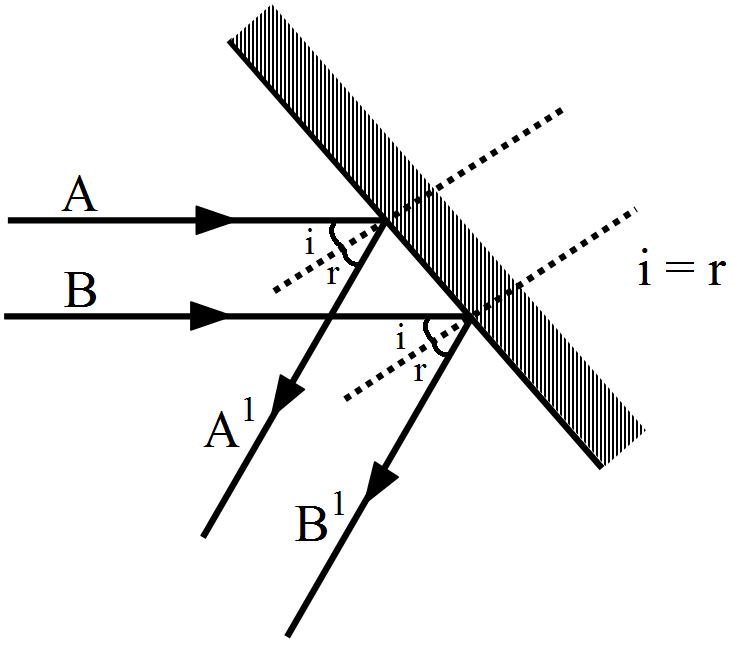
Two rays A and B being reflected by a mirror and going as A' and B'. The mirror:

Answer

  1. Is plane.
Explanation:

Here initially A & B is parallel to each other after reflection by teh plane mirror A' & B' goes Parallel to each other.

Need a full question paper?

Generate a complete, print-ready paper with questions like this in minutes — across 16+ boards, with answer keys.
Start Generating Free

Similar questions

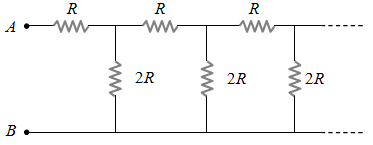
An infinite ladder network is arranged with resistances $R$ and $2 R$ as shown.  The effective resistance between terminals $A$ and $B$ is
1 micro farad =
Induced emf opposes :
Assertion  : The number of electrons in a P-type silicon semiconductor is less than the number of electrons in a pure silicon semiconductor at room temperature.
Reason      : It is due to law of mass action.(a) If both assertion and reason are true and the reason is the correct explanation of the assertion.(b) If both assertion and reason are true but reason is not the correct explanation of the assertion.(c) If assertion is true but reason is false.(d) If the assertion and reason both are false.


The energy of an $X-$ray photon of wavelength $1.65 A \text { is }\left(h=6.6 \times 10^{-34} J-\sec, 1 eV=1.6 \times 10^{-19} J\right)$
The parallel rays of white light are made an incident normally on an air film of uniform thickness. 250 fringes are seen in the transmitted light between 4000$\mathring{\text{A}}$ and 6500$\mathring{\text{A}}$. Thickness of air film is:
There are two conductors X and Y carrying a current I and moving in the same direction. p and q are two electron beams also moving in the same direction. Will there be attraction or repulsion between the 2 conductors and between the two electron beams separately?
Which one of the following is more monocromatic?
Inversion temperature of a thermocouple is the temperature of the hot junction at which the emf is:
Which of the following waves have a maximum frequency?