Question
Which of the following waves have a maximum frequency?

Answer

  1. Gamma rays
Explanation:
Gamma rays have a maximum frequency.

Need a full question paper?

Generate a complete, print-ready paper with questions like this in minutes — across 16+ boards, with answer keys.
Start Generating Free

Similar questions

Some electric bulbs are connected in series across a 220 V supply in a room. If one bulb is fused then remaining bulbs are connected again in series across the same supply. The illumination in the room will(a) Increase(b) Decrease(c) Remains the same (d) Not continuous
       
The radius of curvature of the curved surface of a plano$-$convex lens is $20 \ cm$. If the refractive index of the material of the lens be $1.5$, it will
In LCR series AC circuit.
When light is refracted into a medium:
  1. Its wavelength and frequency both increase
  2. Its wavelength increases but frequency remains unchanged
  3. Its wavelength decreases but frequency remains unchanged.
  4. Its wavelength and frequency both decrease.
When a point source of light is at a distance of one metre from a photo cell, the cut off voltage is found to be $V.$ If the same source is placed at $2\ m$ distance from photo cell, the cut off voltage will be
For continuous X-rays produced wavelength is(a) Inversely proportional to the energy of the electrons hitting the target(b) Inversely proportional to the intensity of the electron beam(c) Proportional to intensity of the electron beam(d) Proportional to target temperature


Two identical induction coils each of inductance $L$ joined in series are placed very close to each other such that the winding direction of one is exactly opposite to that of the other, what is the net inductance
Water is flowing through a long horizontal tube. Let $P_A$ and $P_B$ be the pressures at two points $A$ and $B$ of the tube.
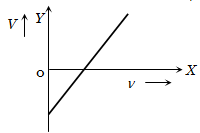
The stopping potential $V$ for photoelectric emission from a metal surface is plotted along $Y-$axis and frequency n of incident light along $X-$axis. A straight line is obtained as shown. Planck's constant is given by
A p-n junction diode cannot be used: