Two resistances ${R_1}$ and ${R_2}$ when connected in series and parallel with $120\, V$ line, power consumed will be $25\, W$ and $100\, W$ respectively. Then the ratio of power consumed by ${R_1}$ to that consumed by ${R_2}$ will be
Medium


Download our appand get started for free
Experience the future of education. Simply download our apps or reach out to us for more information. Let's shape the future of learning together!No signup needed.*
Similar Questions
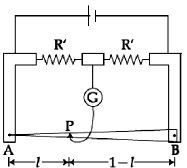
- 1In a meter bridge, the wire of length $1\, m$ has a nonuniform cross-section such that, the variation $\frac{{dR}}{{d\ell }}$ of its resistance $R$ with length $\ell $ is $\frac{{dR}}{{d\ell }} \propto \frac{1}{{\sqrt \ell }}$ Two equal resistances are connected as shown in the figure. The galvanometer has zero deflection when the jockey is at point $P$. What is the length $AP$ ? ................ $m$View Solution
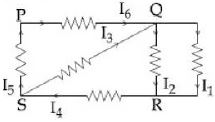
- 2In the given circuit diagram, the currents, ${I_1} = - \,0.3\,A,\,{I_4} = 0.8\,A$ and ${I_5} = 0.4\,A,$ are flowing as shown. The currents $I_2,\,I_3$ and $I_6,$ respectively areView Solution
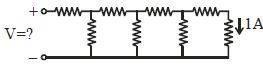
- 3Each element in the finite chain of resistors shown in the figure is $1\,\Omega $. A current of $1\, A$ flows through the final element. Then what is the potential difference $V$ across input terminals of the chain ............... $\mathrm{volt}$View Solution
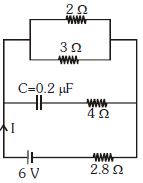
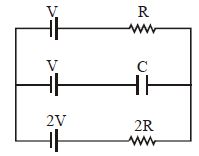
- 4View SolutionIn the given circuit, with steady current, the potential drop across the capacitor must be
- 5A current $I$ flows through a uniform wire of diameter $d,$ when the mean drift velocity is $v_d.$ The same current will flow through a wire of diameter $d/2$ made of the same material, if the mean drift velocity of the electrons isView Solution
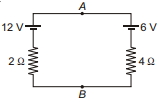
- 6Potential difference across $A B$ i.e., $V_A-V_B$ is ......... $V$View Solution
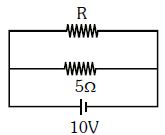
- 7The power dissipated in the circuit shown in the figure is $30\, Watts$. The value of $R$ is ............. $\Omega$View Solution
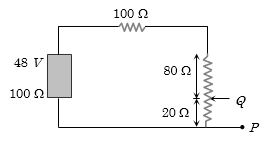
- 8In the circuit, the potential difference across $PQ$ will be nearest to .............. $V$View Solution
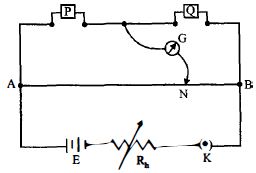
- 9In a meter bridge experiment resistances are connected as shown in the figure. Initially resistance $P\, = 4\,\Omega $ and the neutral point $N$ is at $60\,cm$ from $A$. Now an unknown resistance $R$ is connected in series to $P$ and the new position of the neutral point is at $80\,cm$ from $A$ . The value of unknown resistance $R$ isView Solution
- 10In the given figure the steady state current $I$ is ................. $\mathrm{A}$View Solution