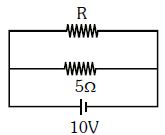
The power dissipated in the circuit shown in the figure is $30\, Watts$. The value of $R$ is ............. $\Omega$
Medium
Download our app for free and get started
Power dissipated in $5\, \Omega$
${=\mathrm{i}^{2} \mathrm{R}} $
${=(2)^{2} \times 5=20 \mathrm{\,W}}$
$\therefore $ Power dissipated in $\mathrm{R}=30-20$
$=10 \mathrm{\,Watt}$
$\therefore \quad 10=\frac{(10)^{2}}{\mathrm{R}}$
$\mathrm{R}=\frac{100}{10}=10\, \Omega$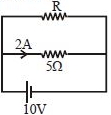

Download our appand get started for free
Experience the future of education. Simply download our apps or reach out to us for more information. Let's shape the future of learning together!No signup needed.*
Similar Questions
- 1The same mass of copper is drawn into two wires $1\, mm$ and $2\, mm$ thick. Two wires are connected in series and current is passed through them. Heat produced in the wire is in the ratioView Solution
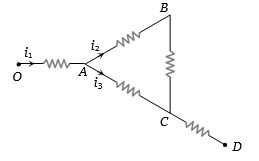
- 2The current in the arm $CD$ of the circuit will beView Solution
- 3$n$ identical bulbs, each designed to draw a power $p$ from a certain voltage supply, are joined in series across that supply. The total power which they will draw isView Solution
- 4When two resistance $R_1$ and $R_2$ connected in series and introduced into the left gap of a meter bridge and a resistance of $10 \Omega$ is introduced into the right gap, a null point is found at $60 cm$ from left side. When $R_1$ and $R_2$ are connected in parallel and introduced into the left gap, a resistance of $3 \Omega$ is introduced into the right-gap to get null point at 40 cm from left end. The product of $R_1 R_2$ is $.............\Omega$View Solution
- 5A battery of $6\, volts$ is connected to the terminals of a three meter long wire of uniform thickness and resistance of the order of $100\,\Omega $. The difference of potential between two points separated by $50\,cm$ on the wire will be .......... $V$View Solution
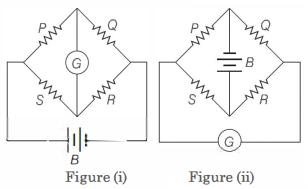
- 6Figure $(i)$ below shows a Wheatstone's bridge in which $P, Q, R$ and $S$ are fixed resistances, $G$ is a galvanometer and $B$ is a battery. For this particular case, the galvanometer shows zero deflection. Now, only the positions of $B$ and $G$ are interchanged, as shown in figure $(ii)$. The new deflection of the galvanometerView Solution
- 7Three resistors each of $2\, ohm$ are connected together in a triangular shape. The resistance between any two vertices will beView Solution
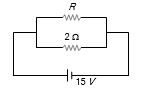
- 8If in the circuit, power dissipation is $150\, W$, then $R$ is ............... $\Omega$View Solution
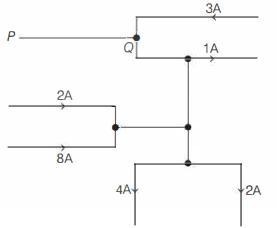
- 9Figure below shows a portion of an electric circuit with the currents in amperes and their directions. The magnitude and direction of the current in the portion $P Q$ isView Solution
- 10What is the equivalent resistance between $A$ and $B$ in the figure below if $R = 3\,\Omega $View Solution