Question
Two resistances when connected in parallel give resultant value of 2 ohm; when connected in series the value becomes 9 ohm. Calculate the value of each resistance.

Answer

Two resistance when connected in series, resultant value is 9 ohms.

Two resistance when connected in parallel, resultant values is 2 ohms.

Let the two resistance be R1 and R2

If connected in series, then

 9 = R1 + R2

R1 = 9 - R2

If connected in parallel, then

$\frac{1}{2}=\frac{1}{\text{R}_1}+\frac{1}{\text{R}_2}$

From aboves equations we get that

$\frac{1}{2}=\frac{(\text{R}_1+\text{R}_2)}{\text{R}_1\text{R}_2}$

$\frac{1}{2}=\frac{9}{(9-\text{R}_2)\text{R}_2}$

$9\text{R}_2-\text{R}_2{^2}=18$

$\text{R}_2{^2}-9\text{R}_2+18=0$

$(\text{R}_2-6)(\text{R}_2-3)=0$

$\text{R}_2=6,3$

So if R2 6 ohms, then R1 = 9 - 6 = 3 ohms.

If R2 = 3 ohms, then R1 = 9 - 3 = 6 ohms.

Need a full question paper?

Generate a complete, print-ready paper with questions like this in minutes — across 16+ boards, with answer keys.
Start Generating Free

Similar questions

A combination of lenses for a camera contains two converging lenses of focal lengths 20cm and 40cm and a diverging lens of focal length 50cm. Find the power and focal length of the combination.
State and explain Joule’s law of heating.
With the help of an activity, explain the method inducing electric current in a coil with a moving magnet. State the rule used to find the direction of electric current thus generated in the coil.
What is lateral inversion? Explain by giving a suitable example.
With the help of a labelled circuit diagram illustrate the pattern of field lines of the magnetic field around a long current carrying straight conducting wire. How is the right hand thumb rule useful to find direction of magnetic field associated with a current carrying conductor?
Distinguish between a convex and a concave mirror.
A magnifying lens has a focal length of 100mm. An object whose size is 16mm is placed at some distance from the lens so that an image is formed at a distance of 25cm in front of the lens.
  1. What is the distance between the object and the lens?
  2. Where should the object be placed if the image is to form at infinity?
How does the resistance of a wire change when:
  1. Its length is tripled?
  2. Its diameter is tripled?
  3. Its material is changed to one whose resistivity is three times?
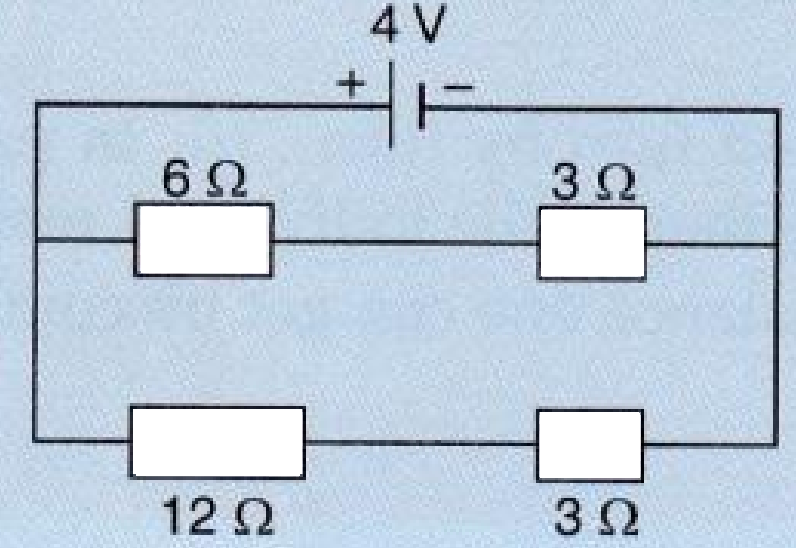
For the circuit shown in the diagram below:

What is the value of :
Current through $6 Ω$ resistor?
Potential difference across $12 Ω$ resistor?