Two rods of copper and iron with the same cross-sectional area are joined at $S$ and a steady current $I$ flows through the rods as shown in the figure. Choose the most appropriate representation of charges accumulated near the junction $S$.
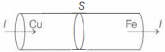
- A
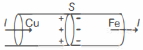
- B
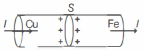
- C
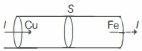
- D
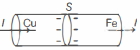
KVPY 2018, Diffcult


Download our appand get started for free
Experience the future of education. Simply download our apps or reach out to us for more information. Let's shape the future of learning together!No signup needed.*
Similar Questions
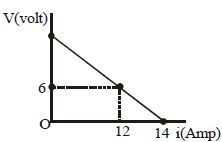
- 1$10\,Cells$, each of emf $'E'$ and internal resistance $'r'$, are connected in series to a variable external resistance. Figure shows the variation of terminal potential difference of their combination with the current drawn from the combination.$Emf$ of each cell is ............. $V$View Solution
- 2In a potentiometer experiment two cells of $e.m.f.$ $E_1$ and $E_2$ are used in series and in conjunction and the balancing length is found to be $58\, cm$ of the wire. If the polarity of $E_2$ is reversed, then the balancing length becomes $29\, cm$. The ratio $\frac{{{E_1}}}{{{E_2}}}$ of the $e.m.f.$ of the two cells isView Solution
- 3$A$ constant voltage is applied between the two ends of a uniform metallic wire. Some heat is developed in it. The heat developed is doubled ifView Solution
- 4A resistance of $2 \Omega$ is comnected across one gap of a metre-bridge (the length of the wire is $100 \mathrm{~cm}$ ) and an unknown resistance, greater than $2 \Omega$, is connected across the other gap. When these resistance are interchanged, the balance point shifts by $20 \mathrm{~cm}$. Neglecting any corrections, the unknown resistance isView Solution
- 5The current $I$ in the given circuit will be $......A$View Solution
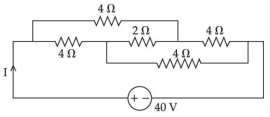
- 6The current in the given circuit is ................ $A$View Solution
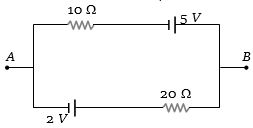
- 7What is the equivalent resistance of the circuit ............. $\Omega$View Solution
- 8A hollow cylindrical conductor has length of $3.14\,m$, while its inner and outer diameters are $4\,mm$ and $8\,mm$ respectively. The resistance of the conductor is $n \times 10^{-3}\,\Omega$.If the resistivity of the material is $2.4 \times 10^{-8}\,\Omega\,m$. The value of $n$ is $..........$View Solution
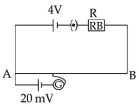
- 9As shown in the figure, a potentiometer wire of resistance $20\,\Omega$ and length $300\,cm$ is connected with resistance box (R.B.) and a standard cell of emf $4\,V$. For a resistance ' $R$ ' of resistance box introduced into the circuit, the null point for a cell of $20\,mV$ is found to be $60\,cm$. The value of ' $R$ ' is $.....\Omega$View Solution
- 10View SolutionThe lead wires should have