MCQ
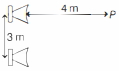
Two small identical speakers are connected in phase to the same source. The speakers are $3 \,m$ apart and at ear level. An observer stands at $P, 4 \,m$ in front of one speaker as shown alongside. The sound she hears is least intense when the wavelength is $\lambda_1$ and most intense when the wavelength is $\lambda_2$. Then, the possible values of $\lambda_1$ and $\lambda_2$ are
  • A
    $\lambda_1=1 \,m$ and $\lambda_2=2 \,m$
  • B
    $\lambda_1=4 \,m$ and $\lambda_2=3 \,m$
  • $\lambda_1=2 \,m$ and $\lambda_2=1 \,m$
  • D
    $\lambda_1=0.5 \,m$ and $\lambda_2=025 \,m$
Answer

Correct option: C.
$\lambda_1=2 \,m$ and $\lambda_2=1 \,m$
c
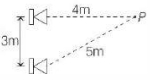
(c) Path difference of sounds from speakers $A$ and $B$ is $1 \,m (=5 \,m -4 \,m )$.

For least intense sound, $1 \,m$ can cause a destructive interference. So, path difference is an odd multiple of half wavelength.

$\Rightarrow \Delta L=(2 n+1) \frac{\lambda_1}{2}$

$\Rightarrow 1 \,m =\frac{\lambda_1, 3 \lambda_1, 5 \lambda_1}{2}, \frac{2}{2}, \text { etc. }$

Above condition is satisfied, when $\lambda_1=2 \,m$.

And for most intense sound, path difference of $1 m$ can cause a constructive interference. So, path difference must be a whole number multiple of one wavelength.

$\Rightarrow \Delta L=n \lambda_2$

$\Rightarrow 1 \,m =\lambda_2, 2 \lambda_2, 3 \lambda_2, \ldots, \text { etc. }$

Above condition is satisf ied with $\lambda_2=1 \,m$.

So, correct option is $(c)$.

Need a full question paper?

Generate a complete, print-ready paper with questions like this in minutes — across 16+ boards, with answer keys.

Start Generating Free

Similar questions

The length of a spring is a when $\alpha $ force of $4\,N$ is applied on it and the length is $\beta $ when $5\,N$ force is applied. Then the length of spring when $9\,N$ force is applied is
A solid cylinder $30\ cm$ in diameter at the top of an inclined plane $2.0\ m$  high is released and rolls down the incline without loss of energy due to friction. Its linear speed at the bottom is.......... $m/\sec$.
A particle executing simple harmonic motion has an amplitude of $6\, cm$. Its acceleration at a distance of $2 \,cm$ from the mean position is $8\,cm/{s^2}$. The maximum speed of the particle is ... $ cm/s$
According to Newton’s law of cooling, the rate of cooling of a body is proportional to ${(\Delta \theta )^n}$, where $\Delta \theta $ is the difference of the temperature of the body and the surroundings, and n is equal to
The equation of state of a gas is given by $\left( {P + \frac{{a{T^2}}}{V}} \right)\,{V^c} = (RT + b)$, where $a, b, c$ and $R$ are constants. The isotherms can be represented by $P = A{V^m} - B{V^n}$, where $A$ and $B$ depend only on temperature then
$ML{T^{ - 1}}$ represents the dimensional formula of
A rocket is fired upward from the earth's surface such that it creates an acceleration of $20\, m/s^2$. If after $5\, s$ its engine is switched off, the maximum height of the rocket  from the earth's surface would be......$m$
A sphere of mass $m$ is set in motion with initial velocity $v_o$ on a surface on which $kx^n$ is the frictional force with $k$ and $n$ as the constants and $x$ as the distance from the point of start. Find the distance in which sphere will stop
$2\, kg$ of ice at $-20°C$ is mixed with $5\, kg$ of water at $20°C$ in an insulating vessel having a negligible heat capacity. Calculate the final mass of water remaining in the container. It is given that the specific heats of water and ice are $1\, kcal/kg\, per °C$ and $0.5\, kcal/kg/°C$ while the latent heat of fusion of ice is $80\, k\,cal/kg$ ........ $kg$
Find the magnitude of the unknown forces $X$ and $Y$ if sum of all forces is zero