MCQ
Two solid cylinders $P$ and $Q$ of same mass and same radius start rolling down a fixed inclined plane form the same height at the same time. Cylinder $P$ has most of its mass concentrated near its surface, while $Q$ has most of its mass concentrated near the axis. Which statement $(s)$ is (are) correct?
  • A
    Both cylinders $P$ and $Q$ reach the ground at the same time
  • B
    Cylinder $P$ has larger linear acceleration than cylinder $Q$.
  • C
    Both cylinder $Q$ reaches the ground with same translational kinetic energy.
  • Cylinder $Q$ reaches the ground with larger angular speed.
Answer

Correct option: D.
Cylinder $Q$ reaches the ground with larger angular speed.
d
$I_p>I_Q $

$a_p=\frac{g \sin \theta}{I_p+m R^2} $

$a_Q=\frac{g \sin \theta}{I_Q+m R^2} $

$a_p < a_Q \Rightarrow v=u+a t \Rightarrow t \propto \frac{1}{a}$

$t_p>t_Q $

$V^2=u^2+2 \text { as } \Rightarrow v \propto a \Rightarrow V_p$

$\text { Translational } K . E .=\frac{1}{2} m V^2 \Rightarrow T R K E_p$

$V=\omega R \Rightarrow \omega \propto V \Rightarrow \omega_p<\omega_Q$

Need a full question paper?

Generate a complete, print-ready paper with questions like this in minutes — across 16+ boards, with answer keys.

Start Generating Free

Similar questions

If $I_1, I_2$ and $I_3$ are moments of inertia of solid sphere, hollow sphere and a ring of same mass and radius about geometrical axis, which of the following statements hold good ?
A man can swim with velocity $v$ relative to water. He has to cross a river of width $d $ flowing with a velocity $u (u > v)$. The distance through which he is carried down stream by the river is $x$. Which of the following statement is correct
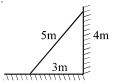
$A$ uniform ladder of length $5m$ is placed against the wall as shown in the figure. If coefficient of friction $\mu$ is the same for both the walls, what is the minimum value of $\mu$ for it not to slip?
Two long capillary tubes $A$ and $B $ of radius $R_B>R_A$ dipped in same liquid. Then
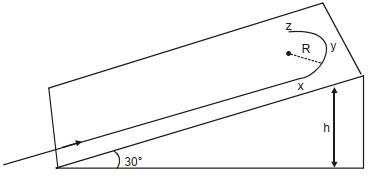
A student skates up a ramp that makes an angle $30^{\circ}$ with the horizontal. $He /$ she starts (as shown in the figure) at the bottom of the ramp with speed $v_0$ and wants to turn around over a semicircular path xyz of radius $R$ during which he/she reaches a maximum height $h$ (at point y) from the ground as shown in the figure. Assume that the energy loss is negligible and the force required for this turn at the highest point is provided by his/her weight only. Then ( $g$ is the acceleration due to gravity)

$(A)$ $v_0^2-2 g h=\frac{1}{2} g R$

$(B)$ $v_0^2-2 g h=\frac{\sqrt{3}}{2} g R$

$(C)$ the centripetal force required at points $x$ and $z$ is zero

$(D)$ the centripetal force required is maximum at points $x$ and $z$

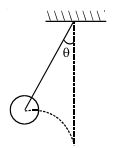
A ball is held in the position shown with string of length $1\,\, m$ just taut & then projected horizontally with a velocity of $3 \,\,m/s$. If the string becomes taut again when it is vertical, angle $\theta$ is given by  ........ $^o$
A boat covers certain distance between two spots in a river taking $t_1$ hrs going downstream and $t_2$ hrs going upstream. What time will be taken by boat to cover same distance in still water?
A mass $m$ moving horizontally (along the $x-$ axis) with velocity $v$ collides and sticks to a mass of $3m$ moving vertically upward (along the $y-$ axis) with velocity $2v$. The final velocity of the combination is
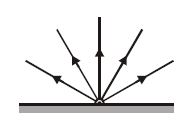
On a windless day, sound emanate isotropically from a point source. Rays of the sound waves emanated from a point source placed close to ground are shown in the figure. Consider horizontal wind towards the left blowing with constant velocity, which is uniform everywhere. In the following figures, rays of sound waves in presence of the wind are shown. Which one is the most correct representation?
A mass of $50\,g$ of water in a closed vessel, with surroundings at a constant temperature takes $2\, minutes$ to cool from $30\,^oC$ to $25\,^oC$. A mass of $100\,g$ of another liquid in an identical vessel with identical surroundings takes the same time to cool from $30\,^oC$ to $25\,^o C$. The specific heat of the liquid is .......... $kcal/kg$ (The water equivalent of the vessel is $30\,g$.)