Two springs with spring constants ${K_1} = 1500\,N/m$ and ${K_2} = 3000\,N/m$ are stretched by the same force. The ratio of potential energy stored in spring will be
Easy
Download our app for free and get started
(a) $U = \frac{{{F^2}}}{{2K}}$
$\Rightarrow U \propto \frac{1}{K}$
$\Rightarrow \frac{{{U_1}}}{{{U_2}}} = \frac{{{K_2}}}{{{K_1}}} = 2$

Download our appand get started for free
Experience the future of education. Simply download our apps or reach out to us for more information. Let's shape the future of learning together!No signup needed.*
Similar Questions
- 1Equations $y = 2A \cos ^2 \omega \,t$ and $y = A (\sin \omega t + \cos \omega t )$ represent the motion of two particles.View Solution
- 2View SolutionIn simple harmonic motion, the ratio of acceleration of the particle to its displacement at any time is a measure of
- 3A simple pendulum consisting of a light inextensible string of length $\ell$ attached to a heavy small bob of mass $m$ is at rest. The bob is imparted a horizontal impulsive force which gives it a speed of $\sqrt{4 g \ell}$. The speed of the bob at its highest point is ( $g$ is the accelaration due to gravity)View Solution
- 4A simple pendulum is hanging from a peg inserted in a vertical wall. Its bob is stretched in horizontal position from the wall and is left free to move. The bob hits on the wall the coefficient of restitution is $\frac{2}{{\sqrt 5 }}$. After how many collisions the amplitude of vibration will become less than $60°$View Solution
- 5The displacement of a particle from its mean position (in metre) is given byView Solution
$y = 0.2\sin \left( {10\pi t + 1.5\pi } \right)\cos \left( {10\pi t + 1.5\pi } \right)$
The motion of particle is
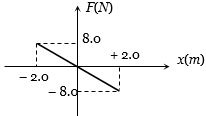
- 6A body of mass $0.01 kg$ executes simple harmonic motion $(S.H.M.)$ about $x = 0$ under the influence of a force shown below : The period of the $S.H.M.$ is .... $s$View Solution
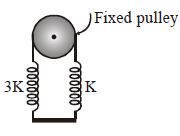
- 7A bar of mass $m$ is suspended horizontally on two vertical springs of spring constant $k$ and $3k$ . The bar bounces up and down while remaining horizontal. Find the time period of oscillation of the bar (Neglect mass of springs and friction everywhere).View Solution
- 8The kinetic energy of a particle executing $S.H.M.$ is $16\, J$ when it is in its mean position. If the amplitude of oscillations is $25\, cm$ and the mass of the particle is $5.12\, kg$, the time period of its oscillation isView Solution
- 9The acceleration $a$ of a particle undergoing $S.H.M.$ is shown in the figure. Which of the labelled points corresponds to the particle being at -$x_{max}$View Solution
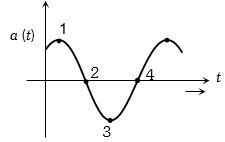
- 10A particle performs simple harmonic motion with amplitude $A$. Its speed is trebled at the instant that it is at a distance $\frac{{2A}}{3}$ from equilibrium position. The new amplitude of the motion isView Solution