MCQ
Two stones are thrown with same speed $u$ at different angles from ground in air. If both stones have same range and height attained by them are $h_1$ and $h_2$, then $h_1+h_2$ is equal to .......
  • A
    $\frac{u^2}{g}$
  • $\frac{u^2}{2 g}$
  • C
    $\frac{u^2}{3 g}$
  • D
    $\frac{u^2}{4 g}$

Answer

Correct option: B.
$\frac{u^2}{2 g}$
b
(b)

If range is same then, one angle is $\theta$ and other angle is $(90-\theta)$

$\Rightarrow h_1=\frac{u^2 \sin ^2 \theta}{2 g}, h_2=\frac{u^2 \sin ^2(90-\theta)}{2 g}$

$h_1=\frac{u^2 \sin ^2 \theta}{2 g}, h_2=\frac{u^2 \cos ^2 \theta}{2 g}$

So, $h_1+h_2 \Rightarrow \frac{u^2 \sin ^2 \theta}{2 g}+\frac{u^2 \cos ^2 \theta}{2 g}=\frac{u^2}{2 g}\left(\sin ^2 \theta+\cos ^2 \theta\right)$

$h_1+h_2=\frac{u^2}{2 g}$

Need a full question paper?

Generate a complete, print-ready paper with questions like this in minutes — across 16+ boards, with answer keys.

Start Generating Free

Similar questions

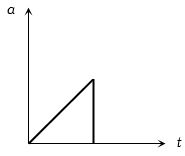
The acceleration-time graph of a body is shown below The most probable velocity-time graph of the body is
A hot body will radiate heat most rapidly if its surface is
A boy walks to his school at a distance of $6\, km$ with constant speed of $2.5\, km/hour $ and walks back with a constant speed of $4 \,km/hr.$ His average speed for round trip expressed in $km/hour$, is
A ball with an initial momentum $p$ collides normally with a rigid wall. If $p'$ is its linear momentum after the perfectly elastic collision, then:
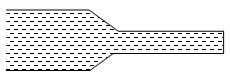
Water flows through a frictionless duct with a cross-section varying as shown in fig. Pressure $p$  at points along the axis is represented by
A block of mass $1 \,kg$ slides down on a rough inclined plane of inclination $60^°$ starting from its top. If the coefficient of kinetic friction is $0.5$ and length of the plane is $1 \,m$, then work done against friction is ........ $J$
$Assertion :$ A transverse waves are produced in a very long string fixed at one end. Only progressive wave is observed near the free end.
$Reason :$ Energy of reflected wave does not reach the free end.
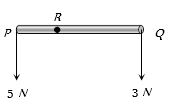
The resultant of the system in the figure is a force of $8N$ parallel to the given force through $R$. The value of $PR$ equals to 
Two springs with spring constants ${K_1} = 1500\,N/m$ and ${K_2} = 3000\,N/m$ are stretched by the same force. The ratio of potential energy stored in spring will be
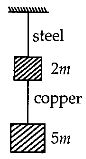
If the ratio of diameters, lengths and Young's modulus of steel and copper wires shown in the figure are $p, q$ and $s$ respectively, then the corresponding ratio of increase in their lengths would be