Question
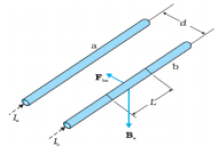
  1. Two straight long parallel conductors carry currents I1 and I2 in the same direction. Deduce the expression for the force per unit length between them.

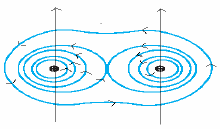
Depict the pattern of magnetic field lines, around them.

  1. A rectangular current carrying loop EFGH is kept in a uniform magnetic field as shown in the figure.

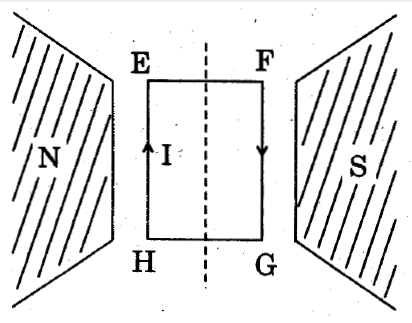
  1. What is the direction of the magnetic moment of the current loop?
  2. When is the torque acting on the loop (A) maximum, (B) zero?

Answer

Derivation of force per unit length:

Figure shows two long parallel conductors a and b separated by a distance d and carrying (parallel) currents Ia and Ib, respectively. The conductor ‘a’ produces, the same magnetic field Ba at all points along the conductor ‘b’. The right-hand rule tells us that the direction of this field is downwards (when the conductors are placed horizontally). From Ampere’s circuital law, its magnitude is given by

$\text{B}_{a} = \frac{\mu_{0}\text{I}_{a}}{2\pi\text{d}}$

The conductor ‘b’ carrying a current Ib will experience a sideways force due to the field Ba. The direction of this force is towards the conductor ‘a’. We label this force as Fba, the force on a segment L of ‘b’ due to ‘a’. The magnitude of this force is given by.

$\text{F}_{ba} = \text{I}_{b }\text{L B}_{a} = \frac{\mu_{0}\text{I}_{a}\text{I}_{b}}{2\pi\text{d}}\text{L}$

Let fba represent the magnitude of the force Fba per unit length. Then, from the above equation

$\text{f}_{ba} = \frac{\mu_{0}\text{I}_{a}\text{I}_{b}}{2\pi\text{d}}$

Pattern of Magnetic Field lines:

  1.  
    1. Direction of magnetic moment $\overrightarrow{\text{M}}$ of the current loop is perpendicular to the plane of the page and directed downwards.
    2.  
      1. Torque acting on the loop is maximum when $\overrightarrow{\text{M}}$ is perpendicular dicular to $\overrightarrow{\text{B}}.$
      2. It is minimum when $\overrightarrow{\text{M}}$ is parallel to $\overrightarrow{\text{B}}.$

Need a full question paper?

Generate a complete, print-ready paper with questions like this in minutes — across 16+ boards, with answer keys.

Start Generating Free

Similar questions

A satellite is projected vertically upwards from an earth station. At what height above the earth's surface will the force on the satellite due to the earth be reduced to half its value at the earth station? (Radius of the earth is 6400km.)
A cylindrical vessel, whose diameter and height both are equal to 30cm, is placed on a horizontal surface and a small particle P is placed in it at a distance of 5.0cm from the centre. An eye is placed at a position such that the edge of the bottom is just visible. The particle P is in the plane of drawing. Up to what minimum height should water be poured in the vessel to make the particle P visible?

Each of the capacitors shown in figure has a capacitance of $2\mu\text{F}.$ Find the equivalent capacitance of the assembly between the points A and B. Suppose, a battery of emf 60 volts is connected between A and B. Find the potential difference appearing on the individual capacitors.

How many wavelengths are emitted by atomic hydrogen in visible range (380nm-780nm)? In the range 50nm to 100nm?
Consider a solid sphere of radius r and mass m that has a charge q distributed uniformly over its volume. The sphere is rotated about its diameter with an angular speed $\omega.$ Show that the magnetic moment $\mu$ and the angular momentum l of the sphere are related as $\mu=\frac{\text{q}}{2\text{m}}\text{l}.$
Explain Hertz experiment for communication of electromagnetic waves. Draw labelled diagram of apparatus used in the experiment.
$(or)$
Explain Hertz experiment related with electromagnetic waves and also explain experiments of Jagdish Chandra Basu and Marconi.
$(or)$
Critically evaluate Hertz experiment of production and communication of electromagnetic waves.
A 2kg block is placed over a 4kg block and both are placed on a smooth horizontal surface. The coefficient of friction between the blocks is 0.20. Find the acceleration of the two blocks if a horizontal force of 12N is applied to:
  1. The upper block.
  2. The lower block. Take g = 10m/s2.
Give a brief description of the basic elementary process involved in the photoelectric emission in Einstein’s picture.
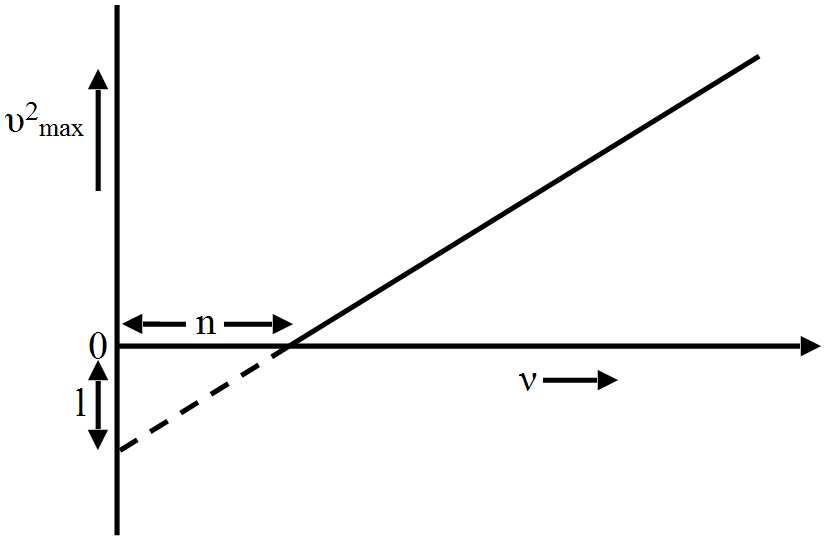
When a photosensitive material is irradiated with the light of frequency v, the maximum speed of electrons is given by vmax. A plot of v2max is found to vary with frequency ν as shown in the figure.

Use Einstein’s photoelectric equation to find the expressions for:
  1. Planck’s constant.
  2. Work function of the given photosensitive material, in terms of the parameters l, n and mass m of the electron.
Consider a p-n junction diode having the characteristic $\text{i}-\text{i}_0\Big(\text{e}^{\frac{\text{eV}}{\text{kT}}}-1\Big)$ where $\text{i}_0=20\mu\text{A}.$ The diode is operated at T = 300K.
  1. Find the current through the diode when a voltage of 300mV is applied across it in forward bias.
  2. At what voltage does the current double?
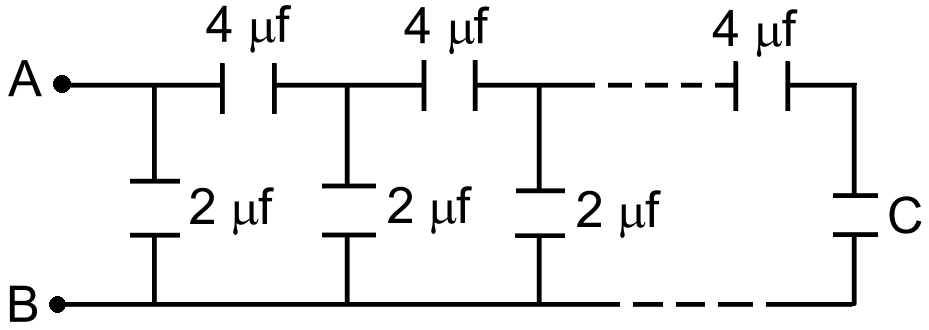
A finite ladder is constructed by connecting several sections of $2\mu\text{F},\ 4\mu\text{F}$ capacitor combinations as shown in figure. It is terminated by a capacitor of capacitance C. What value should be chosen for C, such that the equivalent capacitance of the ladder between the points A and B becomes independent of the number of sections in between?