Two uniform wires $A$ and $B$ are of the same metal and have equal masses. The radius of wire $A$ is twice that of wire $B$. The total resistance of A and $B$ when connected in parallel is
Medium
Download our app for free and get started
$\frac{{{R_A}}}{{{R_B}}} = {\left( {\frac{{{r_B}}}{{{r_A}}}} \right)^4}$ $ \Rightarrow $ $\frac{{{R_A}}}{{{R_B}}} = {\left( {\frac{1}{2}} \right)^4} = \frac{1}{{16}}$ $ \Rightarrow $ ${R_B} = 16{R_A}$
When $R_A$ and $R_B $ are connected in parallel then equivalent resistance
${R_{eq}} = \frac{{{R_A}{R_B}}}{{({R_A} + {R_B})}} = \frac{{16}}{{17}}{R_A}$
If ${R_A} = 4.25\,\Omega $ then ${R_{eq}} = 4\,\Omega $ i.e. option $(a)$ is correct.

Download our appand get started for free
Experience the future of education. Simply download our apps or reach out to us for more information. Let's shape the future of learning together!No signup needed.*
Similar Questions
- 1Two electric bulbs whose resistances are in the ratio of $1 : 2$ are connected in series. The powers dissipated in them have the ratioView Solution
- 2View SolutionA wire of a certain material is stretched slowly by ten percent. Its new resistance and specific resistance become respectively
- 3View SolutionWhich device can convert all electrical energy into heat
- 4View SolutionThe fact that the conductance of some metals rises to infinity at some temperature below a few Kelvin is called
- 5A uniform wire of resistance $9$ $\Omega$ is cut into $3$ equal parts. They are connected in the form of equilateral triangle $ABC$. A cell of $e.m.f.$ $2\,V$ and negligible internal resistance is connected across $B$ and $C$. Potential difference across $AB$ is ............... $V$View Solution
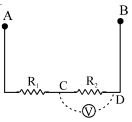
- 6Resistances $R_1$ and $R_2$ each $60\,\Omega$ are connected in series as shown in figure. The Potential difference between $A$ and $B$ is kept $120$ volt. Then what ............. $V$ will be the reading of voltmeter connected between the point $C$ and $D$ if resistance of voltmeter is $120\,\Omega .$View Solution
- 7An ideal gas mixture filled inside a balloon expands according to the relation $PV^{2/3} =$ constant. The temperature inside the balloon isView Solution
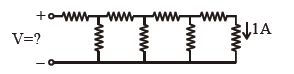
- 8Each element in the finite chain of resistors shown in the figure is $\,1\,\Omega $ . A current of $1\, A$ flows through the final element. Then what is the potential difference $V$ across input terminals of the chain .................. $\mathrm{volt}$View Solution
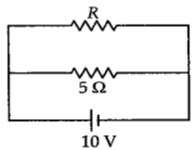
- 9he power dissipated in the circuit shown in the figure is $30\,W$. The value of $R$ is ............. $\Omega$View Solution
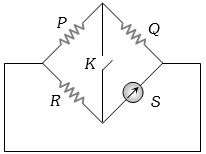
- 10In the following Wheatstone bridge $P/Q = R/S$. If key $K$ is closed, then the galvanometer will show deflectionView Solution