MCQ
Two vectors $\overrightarrow A $ and $\overrightarrow B $ are at right angles to each other, when
  • A
    $\overrightarrow A + \overrightarrow B = 0$
  • B
    $\overrightarrow A - \overrightarrow B = 0$
  • C
    $\overrightarrow A \times \overrightarrow B = 0$
  • $\overrightarrow A \,.\,\overrightarrow B = 0$
Answer

Correct option: D.
$\overrightarrow A \,.\,\overrightarrow B = 0$
d
(d) $\vec A.\vec B = \,|\vec A|.|\vec B|.\cos \theta = \vec A.\vec B.\cos 90^\circ = 0$

Need a full question paper?

Generate a complete, print-ready paper with questions like this in minutes — across 16+ boards, with answer keys.

Start Generating Free

Similar questions

Gravels are dropped on a conveyor belt at the rate of $0.5\, kg/sec$. The extra force required in newtons to keep the belt moving at $2 \,m/sec$ is
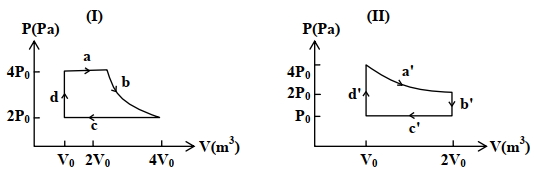
One mole of an ideal gas undergoes two different cyclic processes I and II, as shown in the $P-V$ diagrams below. In cycle I, processes $a, b, c$ and $d$ are isobaric, isothermal, isobaric and isochoric, respectively. In cycle II, processes $a^{\prime}, b^{\prime}, c^{\prime}$ and $d^{\prime}$ are isothermal, isochoric, isobaric and isochoric, respectively. The total work done during cycle I is $W_I$ and that during cycle II is $W_{I I}$. The ratio $W_I / W_{I I}$ is . . . .

(image)

A ball of mass $160\, g$ is thrown up at an angle of $60^{\circ}$ to the horizontal at a speed of $10 \,m / s$. The angular momentum of the ball at the highest point of the trajectory with respect to the point from which the ball is thrown is nearly $\left(g=10\, m / s ^{2}\right)$ (in $kgm ^{2} / s$)
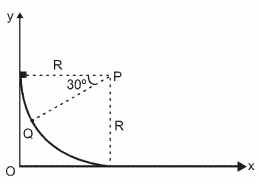
$40 \ m$. The block slides along the track without toppling and a frictional force acts on it in the direction opposite to the instantaneous velocity. The work done in overcoming the friction up to the point $Q$, as shown in the figure below, is $150 \ J$. (Take the acceleration due to gravity, $g =10 \ m s ^{-2}$ )

$1.$ The speed of the block when it reaches the point $Q$ is :

$(A)$ $5 \ ms ^{-1}$ $(B)$ $10 \ ms ^{-1}$$(C)$ $10 \sqrt{3} \ ms ^{-1}$ $(D)$ $20 \ ms ^{-1}$

$2.$ The magnitude of the normal reaction that acts on the block at the point $Q$ is :

$(A)$ $7.5 \ N$ $(B)$ $8.6 \ N$ $(C)$ $11.5 \ N$ $(D)$ $22.5 \ N$

Give the answer question $1$ and $2.$

A screw gauge has $50$ divisions on its circular scale. The circular scale is $4$ units ahead of the pitch scale marking, prior to use. Upon one complete rotation of the circular scale, a displacement of $0.5\, mm$ is noticed on the pitch scale. The nature of zero error involved, and the least count of the screw gauge, are respectively
A particle describes a horizontal circle in a conical funnel whose inner surface is smooth with speed of $0.5 \,m/s$. What is the height of the plane of circle from vertex of the funnel ........ $cm$
The net resistance of an ammeter should be small to ensure that:
When a large bubble rises from the bottom of a lake to the surface, its radius doubles. One atmosphere is equal to that of a column of water of height $H.$ The depth of the lake is:
The length of a simple pendulum is increased by $2\%$. Its time period will
$A$ cylinder of radius $R$ made of a material of thermal conductivity ${K_1}$ is surrounded by a cylindrical shell of inner radius $R$ and outer radius $2R$ made of material of thermal conductivity ${K_2}$. The two ends of the combined system are maintained at two different temperatures. There is no loss of heat across the cylindrical surface and the system is in steady state. The effective thermal conductivity of the system is