Two wires $A$ and $B $ of same material and same mass have radius $2r$ and $r$ . If resistance of wire $A$ is $34\,\Omega $, then resistance of $B$ will be ............ $\Omega$
Medium


Download our appand get started for free
Experience the future of education. Simply download our apps or reach out to us for more information. Let's shape the future of learning together!No signup needed.*
Similar Questions
- 1An ideal gas mixture filled inside a balloon expands according to the relation $PV^{2/3} =$ constant. The temperature inside the balloon isView Solution
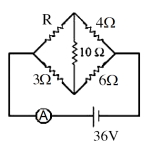
- 2Current measured by the ammeter $(A)$ in the reported circuit when no current flows through $10\,\Omega$ resistance. will be________$A$View Solution
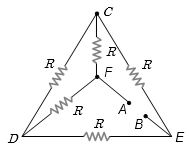
- 3Five equal resistances each of resistance $R$ are connected as shown in the figure. A battery of $V\, volts$ is connected between $A$ and $B$. The current flowing in $AFCEB$ will beView Solution
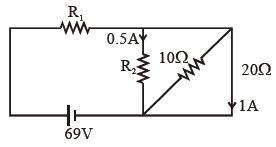
- 4In the circuit shown in the given figure the resistance $R_1$ and $R_2$ are respectivelyView Solution
- 5First, a set of ${n}$ equal resistors of $10\; \Omega$ each are connected in series to a battery of emf $20\; {V}$ and internal resistance $10\; \Omega .$ A current $I$ is observed to flow. Then, the $n$ resistors are connected in parallel to the same battery. It is observed that the current is increased $20$ times, then the value of $n$ is .... .View Solution
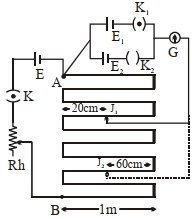
- 6If a wire of resistance $R$ is melted and recasted to half of its length, then the new resistance of the wire will beView Solution
- 7The electric resistance of a certain wire of iron is $R$. If its length and radius are both doubled, thenView Solution
- 8When a wire of uniform cross-section $a$, length $l$ and resistance $R$ is bent into a complete circle, resistance between any two of diametrically opposite points will beView Solution
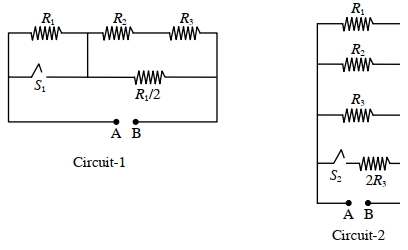
- 9In Circuit-$1$ and Circuit- $2$ shown in the figures, $R_1=1 \Omega, R_2=2 \Omega$ and $R_3=3 \Omega$. $P_1$ and $P_2$ are the power dissipations in Circuit-$1$ and Circuit-$2$ when the switches $S_1$ and $S_2$ are in open conditions, respectively. $Q_1$ and $Q_2$ are the power dissipations in Circuit-$1$ and Circuit-$2$ when the switches $S_1$ and $S_2$ are in closed conditions, respectively.View Solution
Which of the following statement($s$) is(are) correct?
$(A)$ When a voltage source of $6 V$ is connected across $A$ and $B$ in both circuits, $P_1$
$(B)$ When a constant current source of $2 Amp$ is connected across $A$ and $B$ in both circuits, $P_1>P_2$.
$(C)$ When a voltage source of $6 V$ is connected across $A$ and $B$ in Circuit-$1$, $Q_1>P_1$.
$(D)$ When a constant current source of $2 Amp$ is connected across $A$ and $B$ in both circuits, $Q_2$
- 10In the given circuit of potentiometer, the potential difference $E$ across $AB$ ( $10\, m$ length) is larger than $E _{1}$ and $E _{2}$ as well. For key $K _{1}$ (closed), the jockey is adjusted to touch the wire at point $J_{1}$ so that there is no deflection in the galvanometer. Now the first battery $\left( E _{1}\right)$ is replaced by second battery $\left( E _{2}\right)$ for working by making $K _{1}$ open and $K _{2}$ closed. The galvanometer gives then null deflection at $J _{2}$. The value of $\frac{ E _{1}}{ E _{2}}$ is $\frac{ a }{ b },$ where $a =$ ...............View Solution