If a wire of resistance $R$ is melted and recasted to half of its length, then the new resistance of the wire will be
Easy
Download our app for free and get started
(a) $R \propto {l^2} \Rightarrow \frac{{{R_1}}}{{{R_2}}} = {\left( {\frac{{{l_1}}}{{{l_2}}}} \right)^2}$$ \Rightarrow \,\frac{R}{{{R_2}}} = {\left( {\frac{l}{{l/2}}} \right)^2} = 4 \Rightarrow {R_2} = \frac{R}{4}$.

Download our appand get started for free
Experience the future of education. Simply download our apps or reach out to us for more information. Let's shape the future of learning together!No signup needed.*
Similar Questions
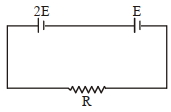
- 1Two cells of emf $2\, E$ and $E$ with internal resistance $r _{1}$ and $r _{2}$ respectively are connected in series to an external resistor $R$ (see $figure$). The value of $R ,$ at which the potential difference across the terminals of the first cell becomes zero isView Solution
- 2The resistance of a heater coil is $110\, ohm$. A resistance $R$ is connected in parallel with it and the combination is joined in series with a resistance of $11\, ohm$ to a $220\, volt$ main line. The heater operates with a power of $110\, watt$. The value of $R$ in $ohm$ isView Solution
- 3A material '$B$' has twice the specific resistance of '$A$'. A circular wire made of '$B$' has twice the diameter ofa wire made of '$A$'. then for the two wires to have the same resistance, the ratio $\frac{{{l_B}}}{{{l_A}}}$ of their respective lengths must beView Solution
- 4When a current of $2\, A$ flows in a battery from negative to positive terminal, the potential difference across it is $12\, V$. If a current of $3 \,A$ flows in the opposite direction potential difference across the terminals of the battery is $15\, V$, the $emf$ of the battery is ................ $\mathrm{V}$View Solution
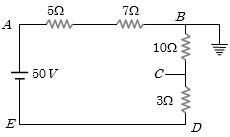
- 5In the circuit shown, the point ‘$B$’ is earthed. The potential at the point ‘$A$’ is ............. $V$View Solution
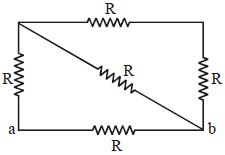
- 6Find out the equivalent resistance between the points $a$ and $b$View Solution
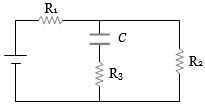
- 7In the circuit here, the steady state voltage across capacitor $C$ is a fraction of the battery $e.m.f.$ The fraction is decided byView Solution
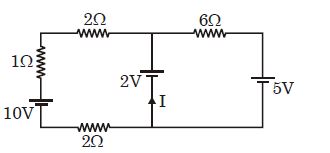
- 8Find the value of $I$ ?................ $\mathrm{A}$View Solution
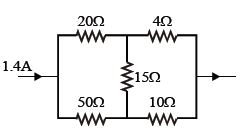
- 9In the given figure the current through $4\,\Omega$ resistor is .................. $\mathrm{A}$View Solution
- 10A cylindrical metal wire of length $l$ and cross sections area $S$, has resistance $R$, conductance $G$, conductivity $\sigma$ and resistivity $\rho$. Which one of the following expressions for $\sigma$ is validView Solution