Two wires of resistance $R_1$ and $R_2$ have temperature coefficient of resistance ${\alpha _1\,}{\rm{ and \,}}{\alpha _2}$, respectively. These are joined in series. The effective temperature coefficient of resistance is
Diffcult


Download our appand get started for free
Experience the future of education. Simply download our apps or reach out to us for more information. Let's shape the future of learning together!No signup needed.*
Similar Questions
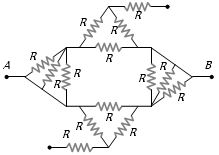
- 1Find equivalent resistance between $A$ and $B$View Solution
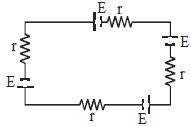
- 2Four identical cells of $EMF$ $E$ and internal resistance $r$ are connected as shown in figure, find terminal voltage across any one cellView Solution
- 3Three resistances, each of $1\, ohm$, are joined in parallel. Three such combinations are put in series, then the resultant resistance will be ............. $ohm$View Solution
- 4An electric wire is connected across a cell of $e.m.f.$ The current $I$ is measured by an ammeter of resistance $R$. According to ohm's lawView Solution
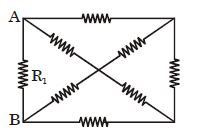
- 5As shown, the circuit is made of $8$ different resistors. It is found that when $R_1 = 4\,\,\Omega,$ the resistance between $A$ and $B$ is $2\,\,\Omega.$ Now replace $R_1$ by a $6\,\,\Omega$ resistor, what is the resistance between $A$ and $B$?View Solution
- 6The two ends of a uniform conductor are joined to a cell of $e.m.f.$ $E$ and some internal resistance. Starting from the midpoint $P$ of the conductor, we move in the direction of current and return to $P$. The potential $V$ at every point on the path is plotted against the distance covered $(x)$. Which of the following graphs best represents the resulting curveView Solution
- 7A wire of length $100\, cm$ is connected to a cell of emf $2\,V$ and negligible internal resistance. The resistance of the wire is $3\,\Omega $. The additional resistance required to produce a potential difference of $1\, mV/cm$ is ............. $\Omega$View Solution
- 8View SolutionThe resistance of an incandescent lamp is
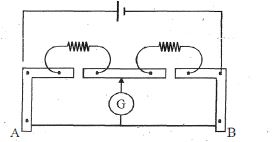
- 9A meter bridge set up as shown to determine end correction at $A$ and $B$ . When a resistance of $15\,\Omega $ is used in left gap and of $20\,\Omega $ in right gap, then null point comes at a distance $42\ cm$ from $A$ . When these resistances are interchanged null point comes at a distance $57\ cm$ from $A$ . Values of end corrections areView Solution
- 10View SolutionFor measurement of potential difference, potentiometer is preferred in comparison to voltmeter because