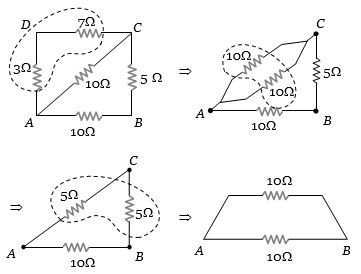
Four resistances $10$ $\Omega$, $5$ $\Omega$, $7$ $\Omega$ and $3$ $\Omega$ are connected so that they form the sides of a rectangle $AB$, $BC$, $CD$ and $DA$ respectively. Another resistance of $10$ $\Omega$ is connected across the diagonal $AC$. The equivalent resistance between $A$ and $B $ is .............. $\Omega$
Medium


Download our appand get started for free
Experience the future of education. Simply download our apps or reach out to us for more information. Let's shape the future of learning together!No signup needed.*
Similar Questions
- 1The resistivity $(\rho)$ of semiconductor varies with temperature. Which of the following curve represents the correct behaviourView Solution
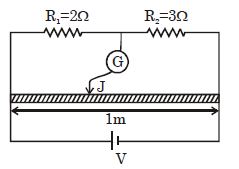
- 2In a meter bridge experiment, initially the jockey is at null point. Now resistance $R_1$ $\&$ $R_2$ is interchanged. Shift in the position of jockey is ................ $cm$View Solution
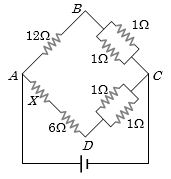
- 3For what value of unknown resistance $X$, the potential difference between $B$ and $D$ will be zero in the circuit shown in the figure ............... $\Omega$View Solution
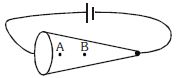
- 4View SolutionSuppose a current carrying wire has a cross-sectional area that, gradually become smaller along the wire, has the shape of a very long cone as shown in figure. Choose the correct statement
- 5A battery consists of a variable number $n$ of identical cells (having internal resistance reach) which are connected in series. The terminals of the battery are short-circuited and the current $I$ is measured. Which of the graphs shows the correct relationship between $I$ and $n \,?$View Solution
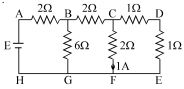
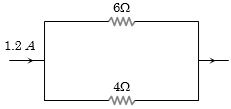
- 6In the figure given below, the current passing through $6\,\Omega $ resistor is ........... $ampere$View Solution
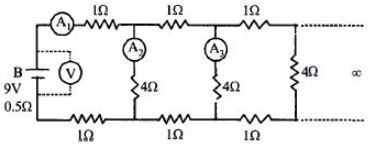
- 7A $9\, V$ battery with internal resistance of $0.5\,\Omega $ is connected across an infinite network as shown in the figure. All ammeters $A_1 , A_2, A_3$ and voltmeter $V$ are ideal. Choose correct statementView Solution
- 8The effective resistance of a parallel connection that consists of four wires of equal length, equal area of cross-section and same material is $0.25\, \Omega$. What will be the effective resistance if they are connected in series ? (In $\Omega$)View Solution
- 9Consider the following two statements.View Solution
$(A)$ Kirchhoff's junction law follows from the conservation of charge.
$(B)$ Kirchhoff's loop law follows from the conservation of energy.
Which of the following is correct ?
- 10The figure shows a network of resistors and $a$ battery. If $1\,A$ current flowsthrough the branch $CF$, then answer the following questions The current throughView Solution