Question
Under what condition the force acting on a charge moving through a uniform magnetic field is minimum?

Answer

$\text{F}_\text{m}=\text{qvB}\sin\theta$; for minimum force $\sin\theta=0$.
i.e., force is minimum when charged particle moves parallel or antiparallel to the field.

Need a full question paper?

Generate a complete, print-ready paper with questions like this in minutes — across 16+ boards, with answer keys.

Start Generating Free

Similar questions

Using figure find the relative luminosity of wavelength:
  1. 480nm
  2. 520nm
  3. 580nm
  4. 600nm

When a current is established in a wire, the free electrons drift in the direction opposite to the current. Does the number of free electrons in the wire continuously decrease?
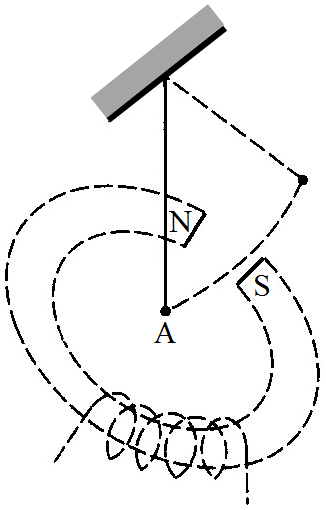
A metallic bob A oscillates through the space between the poles of an electromagnet. The oscillations are more quickly damped when the circuit is on, as compared to the case when the circuit is off. Explain.

An air bubble is formed inside water. Does it act as a converging lens or a diverging lens?
Write the unit of capacitance and its dimensional formula.
A 5.0cm long straight piece of thread is kept on the surface of water. Find the force with which the surface on one side of the thread pulls it. Surface tension of water = 0.076N/m.
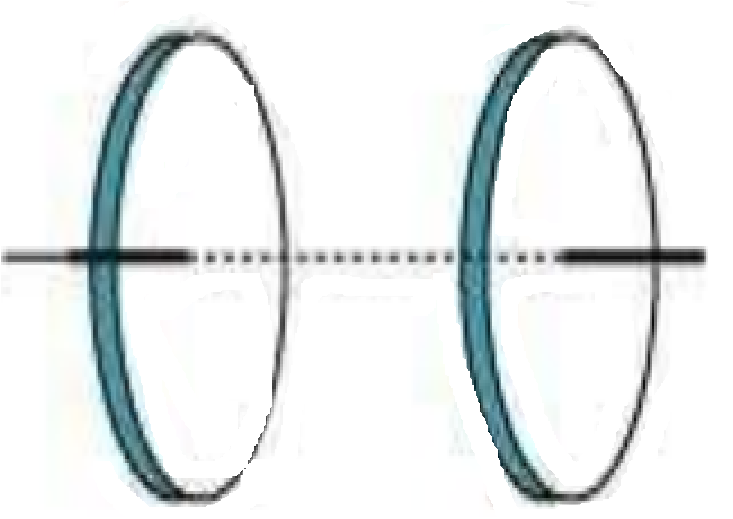
In two co-axial same circular coils, same current is flowing in the same direction. If both the coils are brought towards each other, then what will be the change in the current?
shows a capacitor made of two circular plates each of radius 12 cm, and separated by 5.0 cm. The capacitor is being charged by an external source (not shown in the figure). The charging current is constant and equal to 0.15A.
  1. Calculate the capacitance and the rate of charge of potential difference between the plates.
  2. Obtain the displacement current across the plates.
  3. Is Kirchhoff’s first rule (junction rule) valid at each plate of the capacitor? Explain.
​​​​​​​
Suppose you have three resistors, each of value $30\Omega.$ List all the different resistances you can obtain using them.
Does a gas have just two specific heat capacities or more than two? Is the number of specific heat capacities of a gas countable?