Question
Use a pair of compasses and construct the following angles:
105°

Answer


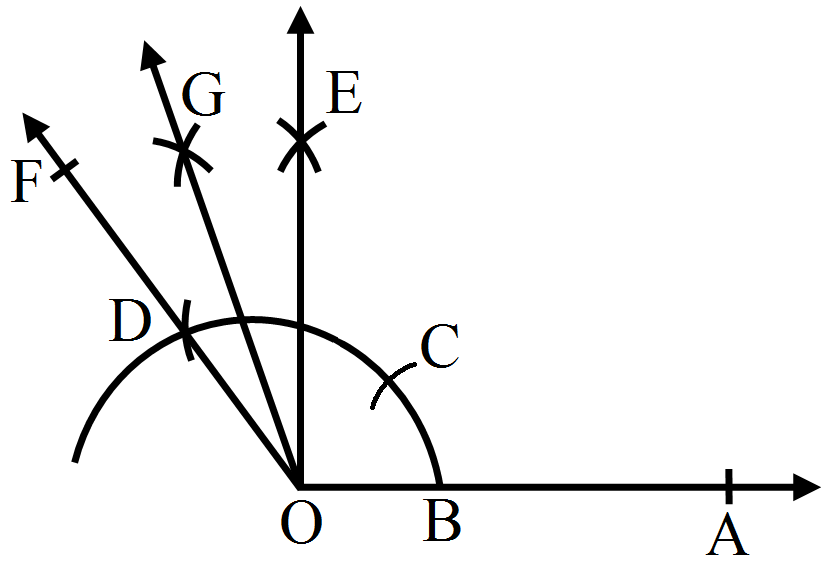
Steps of Construction:
  1. Draw a ray OA.
  2. With O as centre and any suitable radius draw an arc cutting OA at B.
  3. With B as centre and same radius cut the previous arc at C and then with C as centre and same radius cut the arc at D.
  4. With C as centre and radius more than half CD draw an arc.
  5. With D as centre and same radius draw another arc to cut the previous arc at E.
  6. Join OE. Also join OD and produce it to F.
  7. Draw the bisector OG of $\angle\text{EOF}.$
Thus, $\angle\text{AOG}=105^\circ$ is the required angle.

Need a full question paper?

Generate a complete, print-ready paper with questions like this in minutes — across 16+ boards, with answer keys.

Start Generating Free

Similar questions

Using ruler and compasses only, draw an angle of measure 135°.
Match the equivalent fractions and write another 2 for each:
(i) $\frac{250}{400}$ (a) $\frac{2}{3}$
(ii) $\frac{180}{200}$ (b) $\frac{2}{5}$
(iii) $\frac{660}{990}$ (c) $\frac{1}{2}$
(iv) $\frac{180}{360}$ (d) $\frac{5}{8}$
(v) $\frac{220}{550}$ (e) $\frac{9}{10}$
Construct an angle bisector to obtain an angle of 30°.
Match the following columns on whole numbers:
S.No.
Column A
S.No.
Column B
(a)
137 + 63 = 63 + 137
(i)
Associativity of multiplication
(b)
(16 × 25) is a number
(ii)
Commutativity of multiplication
(c)
365 × 18 = 18 × 365
(iii)
Distributive law of multiplication over addition.
(d)
(d) (86 × 14) × 25 = 86 × (14 × 25)
(iv)
Commutativity of addition
(e)
23 × (80 + 5) = (23 × 80) + (23 × 5)
(v)
Closure property for multiplication
Using a protractor, draw $\angle\text{BAC}$ of measure 45°. Take a point P in the interior of $\angle\text{BAC}.$ From P draw line segments PM and PN such that $\text{PM}\perp\text{AB}$ and $\text{PN}\perp\text{AC},$ Measure $\angle\text{MPN}.$
Find the greatest number that will divide 445, 572 and 699, leaving remainders 4, 5, 6 respectively.
Convert into improper fractions:
i. $7 \frac{2}{5}$
ii. $5 \frac{1}{6}$
iii. $4 \frac{3}{4}$
iv. $2 \frac{5}{9}$
v. $1 \frac{5}{7}$
Draw a line segment AB and bisect it. Bisect one of the equal parts to obtain a line segment of length $\frac{1}{2}(\text{AB}).$
Use a pair of compasses and construct the following angles:
150°
$6 \frac{1}{3}+2 \frac{1}{3}$