Magnetic Fields due to Electric Current — Physics STD 12 Science — Question
Maharashtra BoardEnglish MediumSTD 12 SciencePhysicsMagnetic Fields due to Electric Current4 Marks
Question
Using Ampere’s law, derive an expression for the magnetic induction inside an ideal solenoid carrying a steady current.
✓
Answer
An ideal solenoid is tightly wound and infinitely long.
Let $n$ be the number of turns of wire per unit length and $I$ be the steady current in the solenoid.
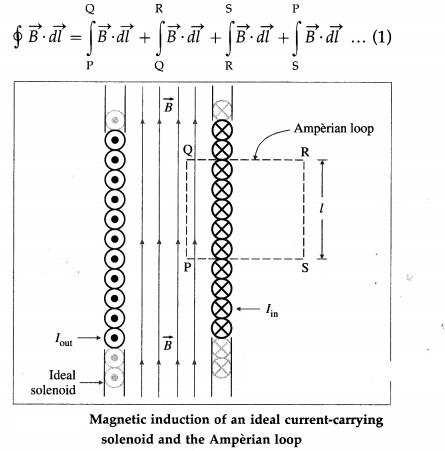
For an ideal solenoid, the magnetic induction $\vec{B}$ inside is reasonably uniform over the cross section and parallel to the axis throughout the volume enclosed by the solenoid; $\vec{B}$ outside is negligible.
As an Amperian loop, we choose a rectangular path $\text{PQRS}$ of length $I$ parallel to the solenoid axis, from below figure.
The width of the rectangle is taken to be sufficiently large so that the side $RS$ is far from the solenoid where $\vec{B}=0$. The line integral of the magnetic induction around the Amperian loop in the sense $\text{PQRSP}$ is
$\vec{B}$ is constant inside and is parallel to side $PQ$.
Hence, as we go in the same direction as $\vec{B}$ from
$P$ to $Q, \vec{B}$ and $\overrightarrow{d l}$ are parallel so that
$\int_{ P } \vec{B} \cdot \overrightarrow{d l}=\int_{ P } B d l=B \int_{ P } d l=B l$
Along the paths $Q \rightarrow R$ and $S \rightarrow P , \vec{B}$ is perpendicular to $\overrightarrow{d l}$ inside the solenoid while $\vec{B}=0$ outside.
$\therefore \int_{ Q }^{ B } \overrightarrow{ B } \cdot \overrightarrow{d l}=\int_{ S }^{ P } \vec{B} \cdot \overrightarrow{d l}=0$
Also $\vec{B}=0$ along side $R$, so that
$\int_{ R }^{ s } \vec{B} \cdot \overrightarrow{d l}=0$
Thus, from Eqs. $(1), (2), (3)$ and $(4),$
$\oint \vec{B} \cdot \overrightarrow{d l}= Bl$
The total current enclosed by the Amperian loop is
Iencl $=$ current through each turn $\times$ number of turns enclosed by the loop
$= I \times n |= n | l$
By Ampere's law,
$\oint \vec{B} \cdot \overrightarrow{d l}=\mu_0 l_{\text {end }}$ (in vacuum)
Therefore, from Eq.s $(5)$ and $(6),$
$B I=\mu_0 n l l$
$\therefore B=\mu_0 n l$
This is the required expression.
$[$Notes: $(1)$ The field inside an ideal solenoid is uniform-it doesn't depend on the distance from the axis.
In this sense, the solenoid is to magnetostatics what the parallel $-$ plate capacitor is to electrostatics; a simple device for producing strong uniform fields.
$(2)$ At an axial point at the end of a long solenoid, $B=\frac{1}{2} \mu_0 nl]$
Need a full question paper?
Generate a complete, print-ready paper with questions like this in minutes — across 16+ boards, with answer keys.