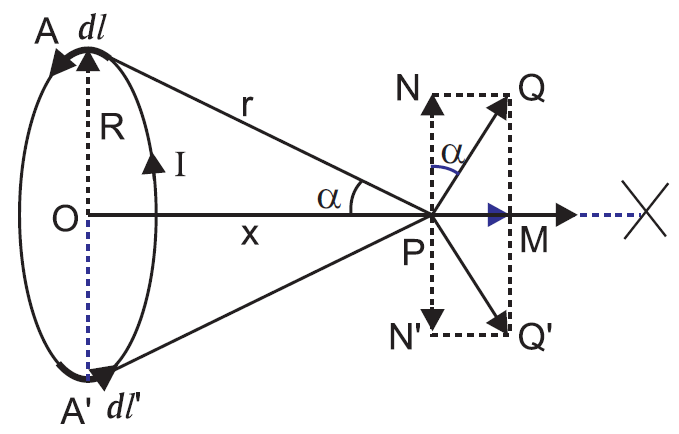
- Magnetic field at the axis of a circular loop: Consider a circular loop of radius R carrying current I, with its plane perpendicular to the plane of paper. Let P be a point of observation on the axis of this circular loop at a distance x from its centre O. Consider a small element of length dl of the coil at point A. The magnitude of the magnetic induction $\overrightarrow{\text{dB}}$at point P due to this element is given by
$\overrightarrow{\text{dB}}= \frac{\mu_{0}}{4\pi}\frac{\text{I}\delta\text{l}\sin\alpha}{\text{r}^{2}}$ - - - - - - (1)
The direction of $\overrightarrow{\text{dB}}$ is perpendicular to the plane containing $\overrightarrow{\text{dl}}$ and $\overrightarrow{\text{r}}$ and is given by right hand screw rule. As the angle between I $\overrightarrow{\text{dl}}$ and $\overrightarrow{\text{r}}$ is 90°, the magnitude of the magnetic induction $\overrightarrow{\text{dB}}$ is given by,
$\overrightarrow{\text{dB}} = \frac{\mu_{0}\text{I}}{4\pi} \frac{\text{dl}\sin90^{o}}{\text{r}^{2}} = \frac{\mu_{0}\text{I}\text{dl}}{4\pi\text{r}^{2}}$ - - - - (2)
If we consider the magnetic induction produced by the whole of the circular coil, then by symmetry the components of magnetic induction perpendicular to the axis will be cancelled out, while those parallel to the axis will be added up. Thus the resultant magnetic induction $\overrightarrow{\text{B}}$ at axial point P is along the axis and may be evaluated as follows:
The component of $\overrightarrow{\text{dB}}$ along the axis,
$\overrightarrow{\text{dB}}_{x} = \frac{\mu_{0}\text{I dl}}{4\pi\text{r}^{2}}\sin\alpha$ - - - - - - (3)
But sin $\alpha =\frac{\text{R}}{\text{r}}\text{ and }\text{r} = (\text{R}^{2} + \text{x}^{2})^{1/2}$
$ \therefore\overrightarrow{\text{dB}}_{x} =\frac{\mu_{0}\text{I dl}}{4\pi\text{r}^{2}}. \frac{\text{R}}{\text{r}} =\frac{\mu_{0}\text{IR}}{4\pi\text{r}^{3}}\text{dl} = \frac{\mu_{0}\text{IR}}{4\pi(\text{R}^{2} +\text{x}^{2})^{3/2}}\text{dl}$ - - - - (4)
Therefore the magnitude of resultant magnetic induction at axial point P due to the whole circular coil is given by
$ \overrightarrow{\text{B}} = \oint\frac{\mu_{0}\text{IR}}{4\pi(\text{R}^{2} + \text{x}^{2})^{3/2}}\text{dl} = \frac{\mu_{0}\text{IR}}{4\pi(\text{R}^{2} + \text{x}^{2})^{3/2}}\oint\text{dl}$
But $\oint\text{dl} = \text{ length of the loop } = 2\pi\text{R}$ - - - - - - - (5)
Therefore, $\text{B} =\frac{\mu_{0}\text{IR}}{4\pi(\text{R}^{2} + \text{x}^{2})^{3/2}}(2\pi\text{R})$
$\overrightarrow{\text{B}} = \text{B}_{x}\hat{i} =\frac{\mu_{0}\text{IR}^{2}}{2(\text{R}^{2} + \text{x}^{2})^{3/2}}\hat{\text{i}}.$
- A long solenoid on bending in the form of closed ring is called a toroidal solenoid.
Figure shows a toroidal solenoid of average radius ‘r’ and of N turns.
For points inside the core of toroid Current I, flowing through it, set up a magnetic field within the core.
According to Ampere’s circuital law
$\oint\overrightarrow{\text{B}}.\overrightarrow{\text{d}l} = \mu_{0}\text{I}$
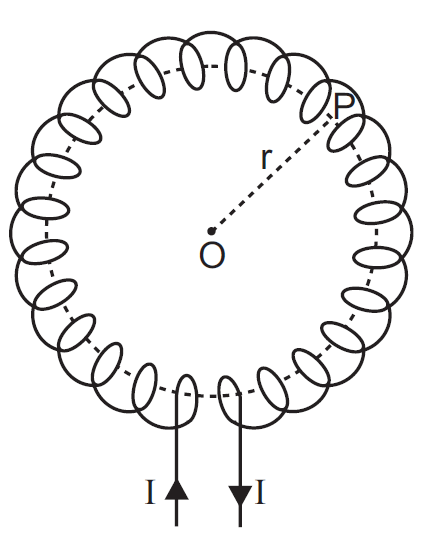
where ‘I’ is the current in the toroid.
Net current =NI
$\therefore\oint\overrightarrow{\text{B}}.\overrightarrow{\text{d}l} = \mu_{0}\text{NI}$
$\Rightarrow|\text{B}|2\pi\text{r} = \mu_{0}\text{NI}$
$\Rightarrow|\text{B}| = \frac{\mu_{0}\text{NI}}{2\pi\text{r}}$
$ = \mu_{0}\text{n} \text{I}$
$\bigg[\because\text{n} = \frac{\text{N}}{2\pi\text{r}}\bigg]$
- For points in the open space inside the toroid: No current flows through the Amperian loop, so I =0
$\oint\overrightarrow{\text{B}}. \overrightarrow{\text{d}l} = \mu_{0|}\text{I} = 0 $
$\Rightarrow|\text{B}|_{inside} = 0 $
- For points in the open space exterior to the toroid : The net current entering the plane of the toroid is exactly cancelled by the net current leaving the plane of the toroid.
$\oint\overrightarrow{\text{B}}.\overrightarrow{\text{d}l} = 0$
$\Rightarrow|\text{B}|_{exterior}= 0.$