Question
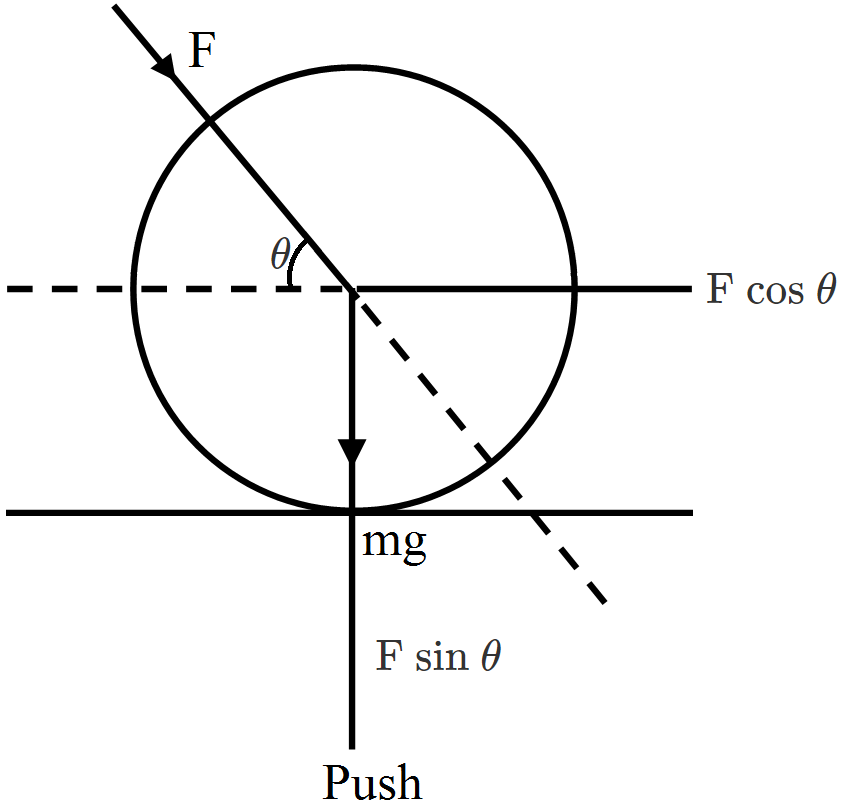
Using component of force, show that it is easier to pull a lawn roller than to push it.
Answer


Apparent weight $=\text{F }\sin\theta+\text{mg}=\text{Reaction (R)}$
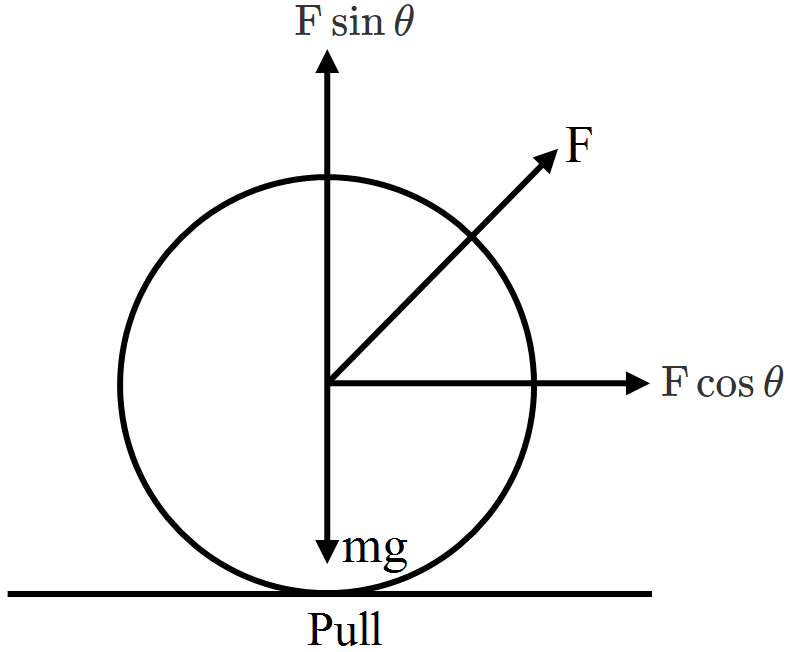
$\Rightarrow\ \text{f}=\mu\text{R}$

Apparent weight $=\text{mg}-\text{F }\sin\theta$
$=\text{Reaction (R}')$
$\text{f}'=\mu\text{R}'$
As f > f'
So, pulling is easier.

Need a full question paper?

Generate a complete, print-ready paper with questions like this in minutes — across 16+ boards, with answer keys.

Start Generating Free

Similar questions

If $\overrightarrow{\text{A}}\times\overrightarrow{\text{B}}=0,$ can you say that:
  1. $\overrightarrow{\text{A}}=\overrightarrow{\text{B}}$
  2. $\overrightarrow{\text{A}}\neq\overrightarrow{\text{B}}$
Find the minimum force required to pull a body up a rough inclined plane $(\theta,\mu).$
Two spheres of the same external radius and made of the same material are heated to the same temperature one of them is hollow and the other is a solid sphere. Whose temperature will fall faster when cooled?
What do you mean by viscosity and terminal velocity?
Is it true that the reaction of a gravitational force is always gravitational, of an electromagnetic force is always electromagnetic and so on?
$1~\text {cm}^3$ sample of oxygen has been given at normal temperature and pressure which sample has more number of molecules?
From the given example, find if the motion is one or two or three$-$dimensional.
  1. A kite flying in the sky.
  2. A cricket ball hit by a player.
  3. Moon revolving around the earth.
  4. The motion of a stone in a circle.
Find the increase in mass when 1kg of water is heated from $0^\circ c$ to $100^\circ C$. Specific heat capacity of water = 4200J/kg-K.
The coil of a moving-coil galvanometer keeps on oscillating for a long time if it is deflected and released. If the ends of the coil are connected together, the oscillation stops at once. Explain
A cylinder of diameter exactly 1cm at 30°C is to be slid into a hole in a steel plate. The hole has a diameter of 0.99970cm at 30°C. To what temperature must the plate be heated? For steel $\alpha-1.1\times10^{-5}(^\circ\text{C}^{-1}).$