Question
Using crystal field theory, draw energy level diagram, write electronic configuration of the central metal atom/ion and determine the magnetic moment value in the following:
  1. $[\text{CoF}_6]^{3-}, [\text{Co(H}_2\text{O})_6]^{2+}, [\text{Co(CN)}_6]^{3-}$
  2. $[\text{FeF}_6]^{3-}, [\text{Fe(H}_2\text{O})_6]^{2+}, [\text{Fe(CN})_6]^{4-}$
Answer

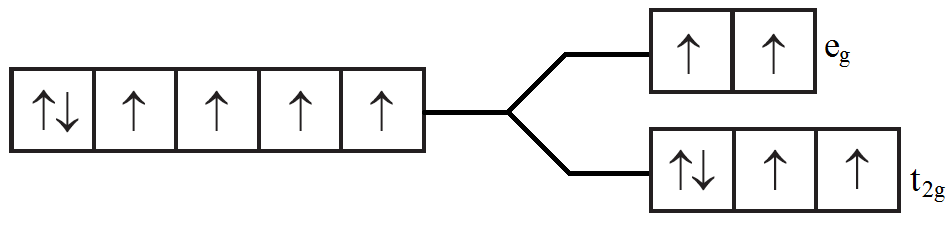
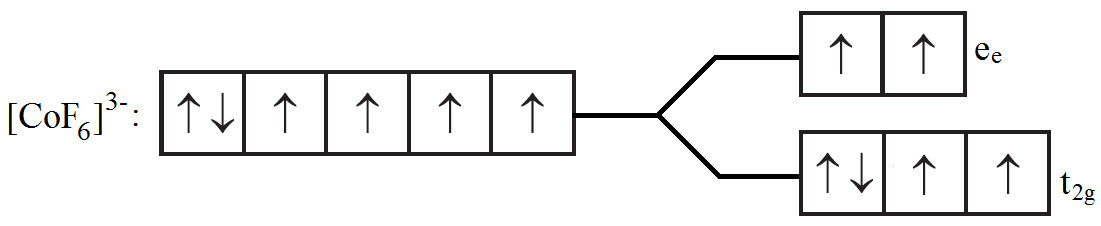
  1.  

$\text{Co}^{2+}=3\text{d}^7$
Number of unpaired electrons = 4
Magnetic moment
$=\sqrt{\text{n}(\text{n}+2)}=\sqrt{4(4+2)}=4.9\text{B.M.}$
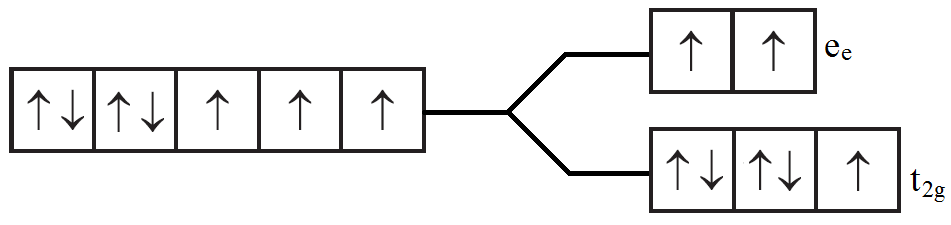
$[\text{Co(H}_2\text{O})_6]^{2+}:$

$\text{Co}^{2+}=3\text{d}^7$
Number of unpaired electrons = 3
Magnetic moment = $\sqrt{3(3+2)}=3.87\text{B.M.}$
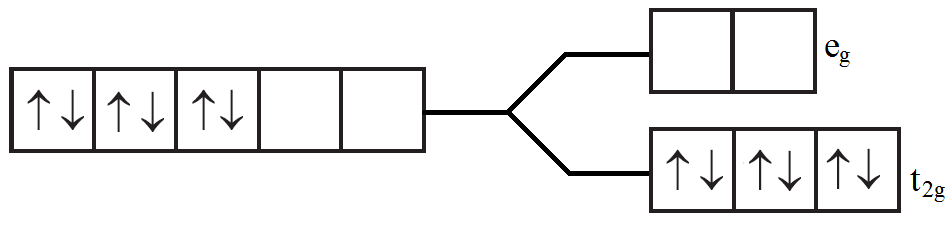
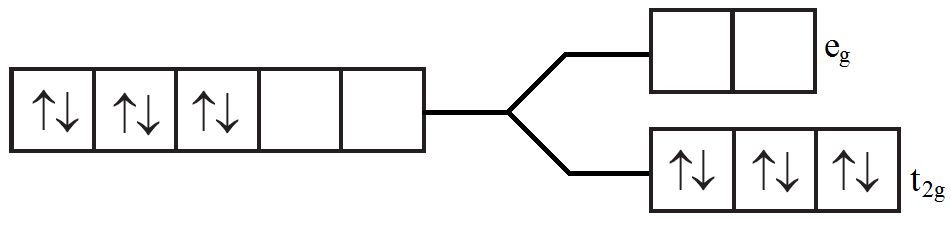
$[\text{Co(CN)}_6]^{3-}:$

$\text{Co}^{3+}=3\text{d}^6$
Number of unpaired electrons = 0
Diamagnetic.
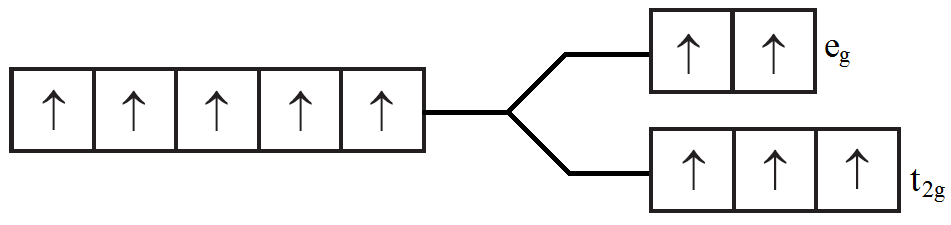
  1. $\text{FeF}^{3-}_6:$

$\text{Fe}^{3+}=3\text{d}^5$
Number of unpaired electrons = 5
Magnetic moment = $\sqrt{5(5+2})=5.92\text{B.M.}$
$[\text{Fe(H}_2\text{O})_6]^{2+}:$

$\text{Fe}^{2+}=3\text{d}^6$
Number of unpaired electrons = 4
Magnetic moment = $\sqrt{4(4+2})=4.9\text{B.M.}$
$[\text{Fe(CN)}_6]^{4-}:$

$\text{Fe}^{2+}=3\text{d}^6$
Diamagnetic.

Need a full question paper?

Generate a complete, print-ready paper with questions like this in minutes — across 16+ boards, with answer keys.

Start Generating Free

Similar questions

Write the IUPAC names of the following coordination compounds:
i. $\left[ Co \left( NH _3\right) 6\right] Cl _3$
ii. $\left[ Co \left( NH _3\right)_5 Cl \right] Cl _2$
iii. $K_3\left[ Fe ( CN )_6\right]$
iv. $K_3\left[ Fe \left( C _2 O _4\right)_3\right]$
v. $K_2\left[P_{d C l}^4\right]$
vi. $\left[ Pt \left( NH _3\right)_2 Cl \left( NH _2 CH _3\right)\right] Cl$
After watching a programme on TV about the presence of carcinogens (cancer causing agents) Potassium bromate and Potassium iodate in bread and other bakery products, Rupali a Class XII student decided to make others aware about the adverse effects of these carcinogens in foods. She consulted the school principal and requested him to instruct the canteen contractor to stop selling sandwiches, pizzas, burgers and other bakery products to the students. The principal took an immediate action and instructed the canteen contractor to replace the bakery products with some protein and vitamin rich food like fruits, salads, sprouts, etc. The decision was welcomed by the parents and the students.
After reading the above passage, answer the following questions:
  1. What are the values (at least two) displayed by Rupali?
  2. Which polysaccharide component of carbohydrates is commonly present in bread?
  3. Write the two types of secondary structures of proteins.
  4. Give two examples of water soluble vitamins.
Match the items of Columns I and II and mark the correct option.
  Column I   Column II
$(A)$ $H_2SO_4$ $(1)$ Highest electron gain enthalpy
$(B)$ $CCl_3NO_2$ $(2)$ Chalcogen
$(C)$ $Cl_2$ $(3)$ Tear gas
$(D)$ Sulphur $(4)$ Storage batteries
  1. $A (4) B (3) C (1) D (2)$
  2. $A (3) B (4) C (1) D (2)$
  3. $A (4) B (1) C (2) D (3)$
  4. $A (2) B (1) C (3) D (4)$
Match the compounds given in Column I with the hybridisation and shape given in Column II and mark the correct option.
  Column I   Column II
(A) $XeF_6$ (1) $sp^3d^3$– distorted octahedral
(B) $XeO_3$ (2) $sp^3d^2$ - square planar
(C) $XeOF_4$ (3) $sp^3$- pyramidal
(D) $XeF_4$ (4) $sp^3d^2$ - square pyramidal
  1. A (1) B (3) C (4) D (2)
  2. A (1) B (2) C (4) D (3)
  3. A (4) B (3) C (1) D (2)
  4. A (4) B (1) C (2) D (3)
The rate constant for the decomposition of $N_2O_5$ at various temperatures is given below:
$T/^\circ C$ $0$ $20$ $40$ $60$ $80$
$105 \times k/s-1$ $0.0787$ $1.70$ $25.7$ $178$ $2140$
Draw a graph between ln $k$ and $1/T$ and calculate the values of $A$ and $E_a$. Predict the rate constant at $30^\circ$ and $50^\circ C.$
How will you distinguish between the following pairs of terms:
  1. Hexagonal close-packing and cubic close-packing?
  2. Crystal lattice and unit cell?
  3. Tetrahedral void and octahedral void?
What are the similarities between lanthanoids and actinoids?
Arrange the following compounds in a decreasing order of basic strength in their aqueous solutions.
$NH_3, CH_3NH_2, (CH_3)_2NH, (CH_3)_3N$
Match the items of Column I with items of Column II and assign the correct code:
 
Column I
 
Column II
$(A)$
Sapphire
$(1)$
$Al_2O_3$
$(B)$
Sphalerite
$(2)$
$NaCN$
$(C)$
Depressant
$(3)$
$CO$
$(D)$
Corundum
$(4)$
$ZnS$
 
 
$(5)$
$Fe_2O_3$
  1. $A (3) B (4) C (2) D (1)$
  2. $A (5) B (4) C (3) D (2)$
  3. $A (2) B (3) C (4) D (5)$
  4. $A (1) B (2) C (3) D (4)$
Explain on the basis of valence bond theory that $\left[ Ni ( CN )_4\right]^{2-}$ ion with square planar structure is diamagnetic and the $\left[ NiCl _4\right]^{2-}$ ion with tetrahedral geometry is paramagnetic.