Question
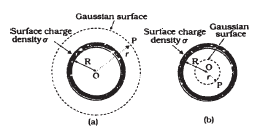
Using Gauss’s theorem, show mathematically that for any point outside the shell, the field due to a uniformly charged thin spherical shell is the same as if the entire charge of the shell is concentrated at the centre. Why do you expect the electric field inside the shell to be zero according to this theorem?
Answer

$\phi =\oint\limits_{s}\overrightarrow{\text{E}}.\overrightarrow{\text{d}}\text{s} = \frac{\text{q}}{\varepsilon_{\circ}}$
Derivation: $\text{E}\times4\pi\text{r}^{2} =\frac{\sigma}{\varepsilon_{\circ}}4\pi\text{R}^{2}$
$\therefore \text{E} = \frac{\sigma\text{R}^{2}}{\varepsilon_{\circ}\text{r}^{2}}$
where $\text{q} = 4\pi\text{R}^{2}\sigma$ is the total charge on the spherical shell. Electrostatic field is zero, since total charge inside the shell is zero or charge reside on the surface of the shell.

Need a full question paper?

Generate a complete, print-ready paper with questions like this in minutes — across 16+ boards, with answer keys.

Start Generating Free

Similar questions

A partially plane polarised beam of light is passed through a Polaroid. Show graphically the variation of the transmitted light intensity with angle of rotation of the Polaroid.
Which among the curves shown in Fig. 1.35 cannot possibly represent electrostatic field lines?
The electric field in a region is given by $\overrightarrow{\text{E}}=\frac{3}{5}\text{E}_0\overrightarrow{\text{i}}+\frac{4}{5}\text{E}_0\overrightarrow{\text{j}}$ with $\text{E}_0=2.0\times10^3\text{NC}^{-1}.$ Find the flux of this field through a rectangular surface of area $0.2m^2$ parallel to the $y-z$ plane.
A monkey of mass $15\ kg$ is climbing on a rope with one end fixed to the ceiling. If it wishes to go up with an acceleration of $1m/s^2,$ how much force should it apply to the rope? If the rope is $5\ m$ long and the monkey starts from rest, how much time will it take to reach the ceiling?
A particle is subjected to two simple harmonic motions, one along the X-axis and the other on a line making an angle of 45° with the X-axis, The two motions are given by,$\text{x}=\text{x}_0\sin\omega\text{t}$ and $\text{s}=\text{s}_0\sin\omega\text{t}$
Find the amplitude of the resultant motion.
A healthy youngman standing at a distance of $7m$ from a $11.8m$ high building sees a kid slipping from the top floor. With what speed $($assumed uniform$)$ should he run to catch the kid at the arms height $(1.8m)$?
Explain that Kirchhoff's second law is law of conservation of energy.
Find the binding energy per nucleon of $\text{ }^{197}_{79}\text{Au}$ if its atomic mass is $196.96u.$
(a) A current-carrying circular loop lies on a smooth horizontal plane. Can a uniform magnetic field be set up in such a manner that the loop turns around itself (i.e., turns about the vertical axis).
(b) A current-carrying circular loop is located in a uniform external magnetic field. If the loop is free to turn, what is its orientation of stable equilibrium? Show that in this orientation, the flux of the total field (external field + field produced by the loop) is maximum.
(c) A loop of irregular shape carrying current is located in an external magnetic field. If the wire is flexible, why does it change to a circular shape?
  1. Using the phenomenon of polarisation, show how transverse nature of light can be demonstrated.
  2. Two polaroids $P_1$ and $P_2$ are placed with their pass axes perpendicular to each other. Unpolarised light of intensity Io is incident on $P_1$. A third polaroid $P_3$ is kept in between $P_1$ and $P_2$ such that its pass axis makes an angle of $30^\circ $ with that of $P_1$. Determine the intensity of light transmitted through $P_1, P_2$ and $P_3$.