Question
  1. Using the data given below, calculate the value of equilibrium constant for the reaction at 298K.

$3\text{CH}\equiv\text{CH}(\text{g})\rightleftharpoons\text{C}_6\text{H}_6(\text{g})$ assuming ideal gas behaviour, $\Delta_\text{f}\text{G}^\circ[\text{HC}\equiv\text{CH(g)}]=2.09\times10^5\text{J mol}^{-1},$ $\Delta_\text{f}\text{G}^\circ[\text{C}_6\text{H}_6(\text{g})]=1.24\times10^5\text{J mol}^{-1},$ R = 8.314JK-1 mol-1.

  1. Based on your calculated value, comment whether this process can be recommended as a practical method for making benzene.
Answer

  1. $\Delta\text{G}^\circ=\Delta_\text{f}\text{G}^\circ[\text{C}_6\text{H}_6(\text{g})]-3\Delta_\text{f}\text{G}^\circ[\text{CH}\equiv\text{CH(g)}]$

$=1.24\times10^5\text{J mol}^{-1}-3\times2.09\times10^5\text{J mol}^{-1}$

$=1.24\times10^5\text{J mol}^{-1}-6.27\times10^5\text{J mol}^{-1}$

$=-5.03\times10^5\text{J mol}^{-1}$

$-5.03\times10^5=-2.303\times8.314\times298\log\text{K}$

$\Rightarrow\log\text{K}=\frac{5.03\times10^5\text{J}}{5705.8\text{J}}=+88.1559$

$\Rightarrow\text{K}=1.432\times10^{88}$

  1. Yes, this process can be recommended as a practical method for making benzene as value of K is very high.

Need a full question paper?

Generate a complete, print-ready paper with questions like this in minutes — across 16+ boards, with answer keys.

Start Generating Free

Similar questions

Use the following data to calculate the $\Delta\text{G}^{\circ}$ for the reaction in which PF5(g) forms from PF3(g) and F2(g) at 298K.

PF3(g) + F2(g) → PF5(g)

$\begin{matrix}\Delta \text{H}^{\circ}_{f} & -919 \text{kJ mol}^{-1} & 0 & -1577 \text{kJ} \text{ K}^{-1} \text{mol}^{-1} \ \\\text{S}^{\circ}& 273 & 203 & 301 \end{matrix}$

Draw the resonating structure of
1. ozone molecule
2. nitrate ion
The bromine atom possesses 35 electrons. It contains 6 electrons in 2p orbital, 6 electrons in 3p orbital and 5 electron in 4p orbital. Which of these electron experiences the lowest effective nuclear charge?
  1. Write the general electronic configuration of Group 17 elements.
  2. What is the oxidation state and covalency of Al in [AlCl(H2O)5]2+?
  3. Which out of the following will have the most negative electron gain enthalpy and which have the least negative?

P, S, Cl and F.

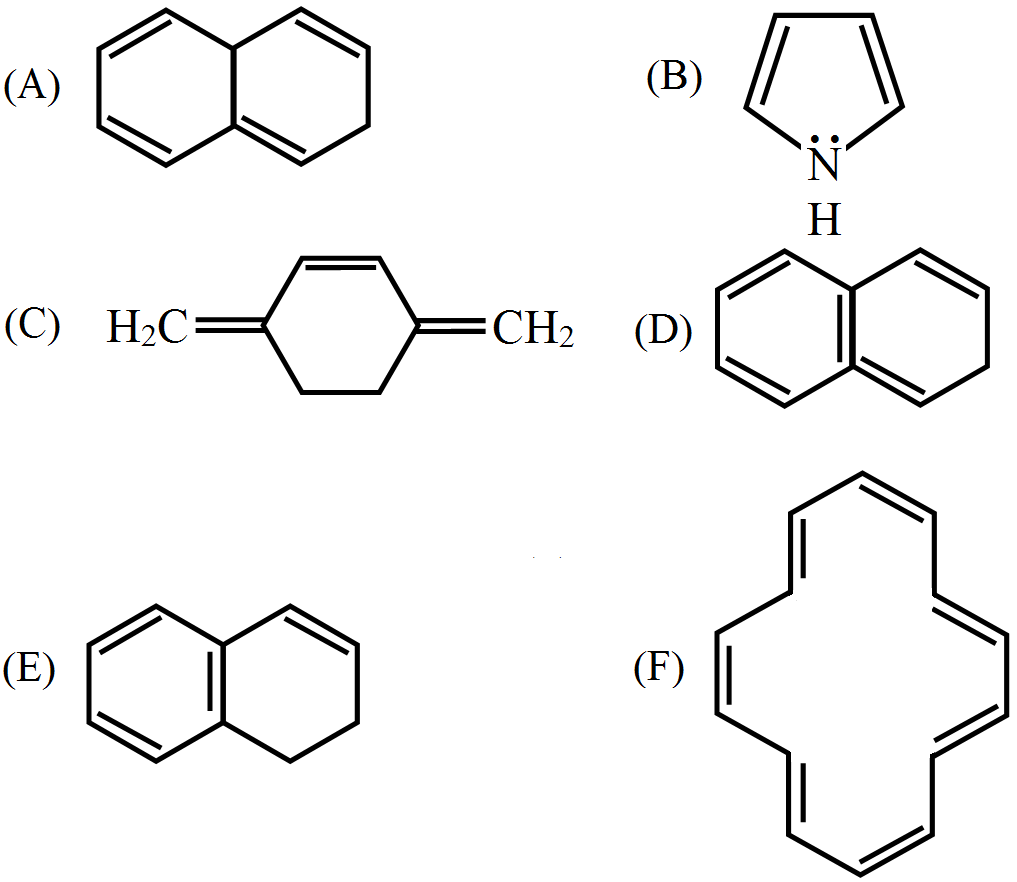
Which of the following compounds are aromatic according to Huckel's rule?

Balance the following equations by the oxidation number method.
$\text{Fe}^{2+}+\text{H}^++\text{Cr}_2\text{O}^{2-}_7\xrightarrow{ \ \ \ \ \ \ \ \ \ }\text{Cr}^{3+}+\text{Fe}^{3+}+\text{H}_2 \text{O}$
For the following compound, write structural formulas and IUPAC names for all possible isomers having the number of double or triple bond as indicated:
C4H8 (one double bond).
According to de Broglie, matter should exhibit dual behaviour, that is both particle and wave like properties. However, a cricket ball of mass 100g does not move like a wave when it is thrown by a bowler at a speed of 100km/ h. Calculate the wavelength of the ball and explain why it does not show wave nature.
Apart from tetrahedral geometry, another possible geometry for $C H _{ 4 }$ is square planar with the four H atoms at the corners of the square and the $C$ atom at its centre. Explain why $C H _{ 4 }$ is not square planar?
Hydrogen atom has only one electron, so mutual repulsion between electrons is absent. However, in multielectron atoms mutual repulsion between the electrons is significant. How does this affect the energy of an electron in the orbitals of the same principal quantum number in multielectron atoms?